Quick facts
- The linepH 4.6: at or below it, water bath; above it, pressure canner, no exceptions
- Tomatoes1 Tbsp bottled lemon juice or ¼ tsp citric acid per pint, 2 Tbsp or ½ tsp per quart, every jar
- Pressure at altitudeDial gauge 13 psi from 4,001 to 6,000 ft, 14 from 6,001 to 8,000; weighted 15 psi above 1,000 ft
- Meat75 minutes pints, 90 quarts; raw pack gets no liquid
- Green beans
- 20 minutes pints
- 25 quarts
- pressure canner only
- Tomatoes, water bath, above 6,000 ft
- 55 minutes pints
- 60 quarts
- acid added
- Dry canning in the ovenNot recommended by NCHFP; Mylar and an oxygen absorber instead
- The freezer window48 hours full, 24 half full; can it while it still has ice crystals
The food shopping list: what to buy, how much, shelf life
Canning is how a freezer full of meat becomes a shelf of jars in two days, how a garden gets through the winter, and how the tomatoes get eaten in March. There are two methods and one rule that decides between them. Get the rule right and canning is safe and boring; get it wrong and the jar can kill you without looking or smelling wrong. Every figure on this page is the tested process from the National Center for Home Food Preservation, which publishes the USDA guide, with the altitude columns that matter at 5,000 feet and up.
Which methodWater bathPressureDry canningGrid downIs the jar safeWhat goes wrong
Which method each food needs
Botulism spores sit on most fresh food. In air they are harmless. Sealed in a jar with moisture, no oxygen and not enough acid, they wake up and make toxin within three or four days, and the jar looks fine. Boiling water does not kill the spores; 240°F does. So the question for every food is only this: is it acid enough to stop the spores, or does it need the pressure canner? The NCHFP line is pH 4.6.
Water bath, 212°F
- Qualifies
- Fruit, applesauce, fruit juice, jams, jellies, fruit butters, pickles, relishes, sauerkraut and other fermented foods, salsa from a tested recipe
- With acid added
- Tomatoes and figs: both sit just above 4.6 and must be acidified by the dose below, even if you pressure can them
- Why it works
- Below pH 4.6 the spores cannot grow, so the job is only to kill molds and yeasts, which boiling water does
- Pack
- Hot pack preferred: it drives out air, stops floating and keeps quality longer
Pressure canner, 240 to 250°F
- Required for
- Every vegetable except acidified tomatoes, meat, poultry, fish, stock and broth, soups, dry beans, chili, spaghetti sauce with meat
- Why
- Low acid lets the spores grow, so the jar itself has to reach a temperature that kills them: 10 to 15 psi, 20 to 100 minutes
- Never a water bath
- NCHFP: a boiling-water process for low-acid food would take 7 to 11 hours, and there is no safe water bath option for green beans or any other vegetable
- Pack
- Hot or raw by the recipe; raw-pack meat gets no liquid at all
Not for canning at all
Pureed pumpkin and pumpkin butter, summer squash and zucchini (the process was withdrawn), broccoli, cauliflower, cabbage, Brussels sprouts, wild mushrooms, bread or cake in jars, butter, milk and cream, and anything thickened with flour, starch, pasta, rice or dairy. No tested process exists; freeze or dry them instead. NCHFP FAQ.
Water bath canning
The water bath is a deep pot with a rack, water an inch or two over the jars, and a clock that starts at a full boil. The method is the same for jam, pickles and tomatoes; only the minutes change, and they go up with altitude because water boils cooler up here.
Acidify tomatoes, every time
| Acid | Per pint | Per quart | Note |
|---|---|---|---|
| Bottled lemon juice | 1 tablespoon | 2 tablespoons | Bottled, from concentrate: its acidity is constant. A fresh lemon varies and gets less acidic as it ripens |
| Citric acid | ¼ teaspoon | ½ teaspoon | No flavor; the one to keep on the shelf. The citric acid recipe covers it |
| 5% vinegar | 2 tablespoons | 4 tablespoons | Works, changes the flavor |
Into the jar before the tomatoes. Sugar can go in to balance the taste; the acid cannot come out. Required for whole, crushed and juiced tomatoes, and still required when tomatoes go in the pressure canner. No tomatoes from dead or frost-killed vines. NCHFP.
Headspace: the gap under the lid
Too little and the jar boils over and fails to seal; too much and the air is not driven out and the food darkens.
Jars, lids, packs
Process a load
- Fill the canner, heat the waterCanner about half full. For a raw pack heat the water to 140°F, for a hot pack to 180°F, so the jars are not shocked. Jars go in upright on the rack, never tilted.
- Water over the jarsAdd boiling water until it stands 1 inch over the lids, 2 inches if the process is over 30 minutes. Lid on, heat on high.
- Start the clock at a full boilNot before. Then turn the heat down to hold a gentle but complete boil the whole time, and top up with boiling water if it drops below the lids.
- If the boil stops, start overAny interruption, from a gust of wind to a fuel change, means the full time again from the beginning. Under-processing is invisible.
- Time is up: heat off, lid off, wait 5 minutesLets the jars settle so they do not siphon liquid when lifted.
- Jars out, onto a towel, an inch apartUpright, not tilted, not tightened, not pressed. Leave them alone 12 to 24 hours. Pinging is the seals taking.
- Test every sealLid does not spring back when pressed, rings when tapped with a spoon, sits concave at eye level. Bands off. A jar that failed goes to the fridge and gets eaten first, or is reprocessed within 24 hours with a new lid.
- Label and storeFood and date on the lid. 50 to 70°F, dark, dry, bands off, stacked two high at most. Plan to eat it within a year.
Process times, minutes, by altitude
Minutes in the boiling water. Find your altitude column, then read the row for the jar size you are using; a quart jar of the same food takes longer than a pint because the heat has farther to travel. These are the tested times from the NCHFP recipe pages, which carry the full directions for each food.
| Food | Jar size | To 1,000 ft | 1,001 to 3,000 | 3,001 to 6,000 | Above 6,000 |
|---|---|---|---|---|---|
| Peaches or pears, hot pack | Pints | 20 | 25 | 30 | 35 |
| Quarts | 25 | 30 | 35 | 40 | |
| Applesauce | Pints | 15 | 20 | 20 | 25 |
| Quarts | 20 | 25 | 30 | 35 | |
| Berries, raw pack | Pints | 15 | 20 | 20 | 25 |
| Quarts | 20 | 25 | 30 | 35 | |
| Whole or halved tomatoes in water | Pints | 40 | 45 | 50 | 55 |
| Quarts | 45 | 50 | 55 | 60 | |
| Crushed tomatoes | Pints | 35 | 40 | 45 | 50 |
| Quarts | 45 | 50 | 55 | 60 | |
| Tomato juice | Pints | 35 | 40 | 45 | 50 |
| Quarts | 40 | 45 | 50 | 55 | |
| Apple pie filling, Clear Jel | Pints | 25 | 30 | 35 | 40 |
| Quarts | 25 | 30 | 35 | 40 |
Jams, juice, pickles and salsa use three bands.
| Food | Jar size | To 1,000 ft | 1,001 to 6,000 | Above 6,000 |
|---|---|---|---|---|
| Jams and jellies (half-pints or pints) | Pints | 5 | 10 | 15 |
| Apple juice | Pints | 5 | 10 | 15 |
| Quarts | 5 | 10 | 15 | |
| Quick dill pickles, raw pack | Pints | 10 | 15 | 20 |
| Quarts | 15 | 20 | 25 | |
| Bread and butter pickles | Pints | 10 | 15 | 20 |
| Quarts | 10 | 15 | 20 | |
| Salsa, USDA tested recipe | Pints | 15 | 20 | 25 |
Steam canners
An atmospheric steam canner (a shallow pan of water under a dome) is accepted by NCHFP for acid foods only: vent until a full column of steam, use the same altitude-adjusted time as the water bath, never open it mid-process, and only for processes of 45 minutes or less after the altitude adjustment. Quarts of whole or crushed tomatoes and tomato juice above 1,000 feet are over that line and go in the water bath. NCHFP.
Free download
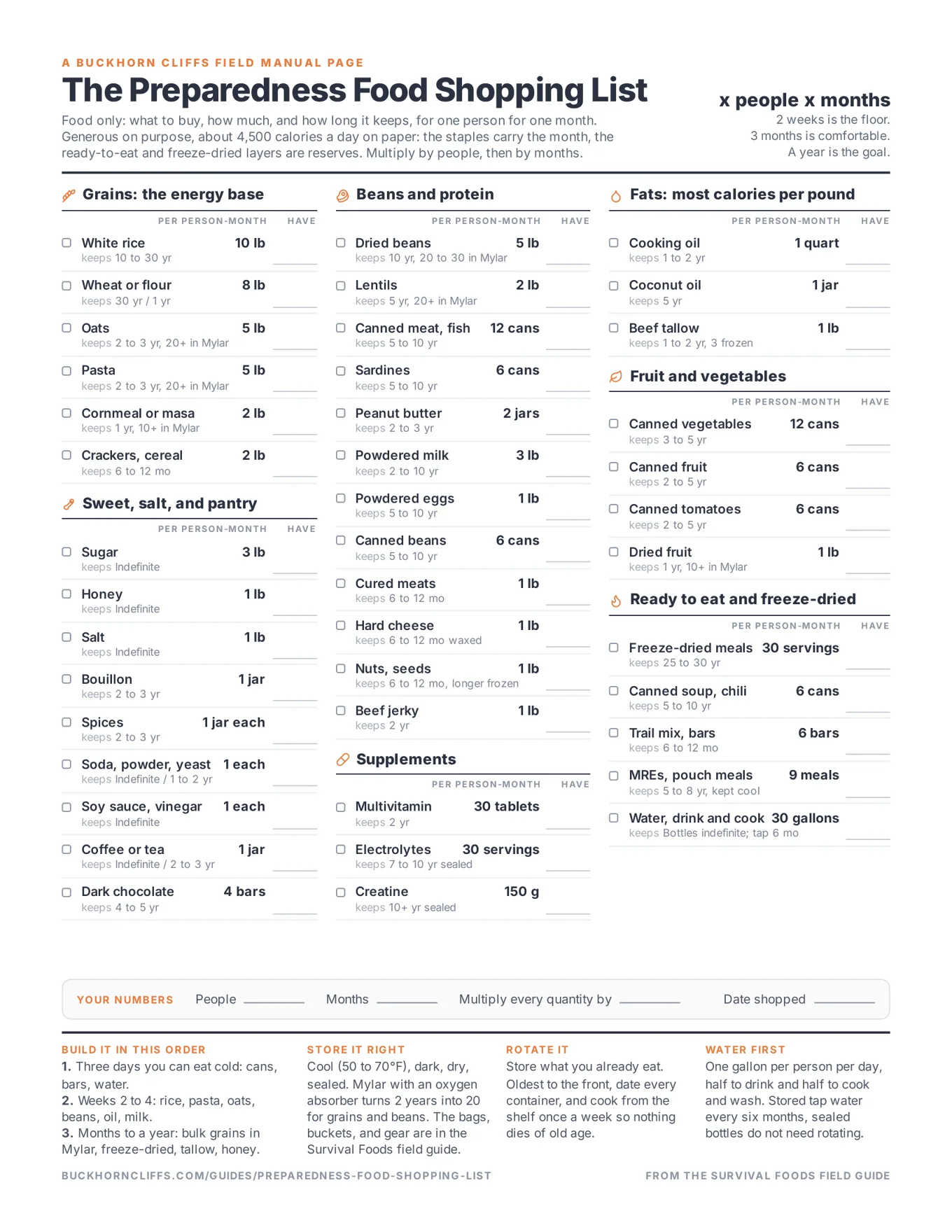
Get the one-page food shopping list
What to store, how much of it for one person for one month, and how long it keeps. One page with checkboxes, built from the Survival Foods field guide. Print it, multiply by your people and months, and take it to the store.
The PDF comes by email, with my newsletter now and then. Already on the list? You still get it. Read the full page.
Pressure canning
A pressure canner is a heavy pot with a locking lid, a vent, a gauge or a weight, and a rack. Steam under pressure runs hotter than boiling water, and that is the whole point: 10 to 15 psi puts the inside of the jar at 240 to 250°F, which kills the spores boiling water leaves alive. The method has more steps than the water bath and every one of them is there for a reason.
- A pressure saucepan or cooker is not a canner: less metal and water means the heat-up and cool-down that the tested times depend on are too short
- Electric multicookers and "pressure cooker" appliances: NCHFP does not support its processes in them, and Utah State found they did not reach canning temperature at Utah altitudes
- NCHFP does not recommend processes above 15 psi, where the USDA tables stop
- A dial gauge is read like a clock and must be tested every year, which county extension offices do; replace it if it is more than 2 pounds off
- A weighted gauge rocks or jiggles at its set pressure and never needs testing; its only limit is that it comes in 5, 10 and 15 pound steps
- A weighted gauge reads by ear: 1 to 4 jiggles a minute on an All American, a steady rock on a Presto
Pressure by altitude
Time stays the same at every altitude; the pressure goes up, because the canner has to reach 240°F and water boils cooler as the air thins. Read your band off the ladder and hold it.
Process a load
- 2 to 3 inches of water, jars inAbout 3 quarts in a 23-quart canner. Heat it to 140°F for raw pack, 180°F for hot pack. Jars upright on the rack, 1 inch headspace (1¼ for poultry), rims wiped, lids on, bands finger-tight.
- Lock the lid, leave the vent open, heat on highWhen steam flows in a steady funnel from the vent, set a timer for 10 minutes and let it vent. This pushes the air out; air in the canner means the inside runs cooler than the gauge says.
- Weight on, come to pressureAfter the 10 minutes, put the weight on the vent. Three to five minutes later the dial reaches the target or the weight starts to rock. The clock starts now.
- Hold it thereTurn the heat down in small steps to hold the pressure at or just above the target. If it ever drops below, bring it back up and start the full time again. Never lift the weight to adjust.
- Time is up: heat off, hands offLet the pressure fall on its own: about 30 minutes for pints, 45 for quarts, longer for a thick-walled canner. No cold water, no cracking the vent. Forced cooling spoils food and siphons liquid out of the jars.
- Zero pressure: weight off, wait 10 minutesWhen the lock drops or the dial reads zero, tilt the weight to check that no steam escapes, lift it off, and wait 10 more minutes. Then open the lid with the underside away from your face.
- Jars out, 12 to 24 hours aloneUpright onto a towel, an inch apart. Do not tighten the bands or press the lids. Boiling inside the jar for a while after is normal.
- Test, strip the bands, label, storePress, tap, look. Bands off. A failed jar to the fridge. The rest to a dark shelf at 50 to 70°F.
Process times at the pressure for your altitude
How long each jar size stays at pressure, after the 10-minute vent. A pint jar and a quart jar of the same food get different times because the heat has farther to travel into a quart. The minutes are the same at every altitude; only the pressure above changes.
| Food | Time, pint jars | Time, quart jars | Pack | Notes |
|---|---|---|---|---|
| Vegetables | ||||
| Green beans | 20 min | 25 min | Hot or raw | No water bath time exists |
| Carrots | 25 min | 30 min | Hot or raw | |
| Corn, whole kernel | 55 min | 85 min | Hot or raw | |
| Peas | 40 min | 40 min | Hot or raw | |
| Potatoes, cubed | 35 min | 40 min | Hot only | Cover with fresh boiling water, not the cooking water |
| Beets | 30 min | 35 min | Hot only | |
| Pumpkin or winter squash, cubed | 55 min | 90 min | Hot only | Never mashed or pureed |
| Dry beans, soaked | 75 min | 90 min | Hot only | Soak 12 to 18 hours, boil 30 minutes first |
| Mixed vegetables | 75 min | 90 min | Hot only | |
| Meat, poultry, fish | ||||
| Meat strips, cubes, chunks | 75 min | 90 min | Hot or raw | Raw pack gets no liquid; salt optional |
| Ground meat | 75 min | 90 min | Hot only | Browned, fat drained, boiling broth or water over |
| Chicken or rabbit, boneless | 75 min | 90 min | Hot or raw | 1¼ inch headspace; raw pack gets no liquid |
| Chicken or rabbit, bone in | 65 min | 75 min | Hot or raw | 1¼ inch headspace |
| Fish | 100 min | own method | Raw | No liquid; quarts have a separate 160-minute procedure |
| Stock, soup, sauce | ||||
| Meat or chicken stock | 20 min | 25 min | Hot | Fat skimmed |
| Soup | 60 min | 75 min | Hot | 100 min with seafood. Jar half solids; no pasta, rice, flour, cream or milk; beans fully rehydrated |
| Chili con carne | 75 min | pints only | Hot | Do not thicken |
| Spaghetti sauce, no meat | 20 min | 25 min | Hot | Tested recipe; do not increase onions, peppers or mushrooms |
| Spaghetti sauce with meat | 60 min | 70 min | Hot | Tested recipe |
Times and packs from the NCHFP recipe pages for each food. The meat and stock times match the carnivore food storage page.
Keep the canner working
Dry canning: three things people mean
Three different things get called dry canning. One is a tested method, one is the safe way to store dry goods, and one is a kitchen myth that NCHFP has put in writing.
- NCHFP calls it not a recommended, science-based method: it has never been shown to sterilize anything, it does not remove oxygen, and it traps moisture that grows mold
- Mason jars are not tempered for the oven and can explode in it; the jar maker does not support the practice
- It speeds rancidity in grains and nuts, and no tested shelf life exists for anything stored this way
- Only food at 10 percent moisture or less and low in oil; moist food in an oxygen-free package is a botulism risk
- Not for brown rice, nuts, whole wheat flour, granola, jerky, dried eggs, or dehydrated produce that bends instead of snapping
- Absorbers: 300 to 500 cc for a gallon bag or #10 can, 1,500 to 2,000 cc for a 5-gallon bag; open only the packets you will use in the next 20 to 30 minutes
- Wheat, white rice, corn and sugar 30 years or more, beans, oats and pasta 30, nonfat milk 20, at 75°F or cooler: usable-in-an-emergency figures, not safety limits
- Meat and poultry raw packed with no liquid is a tested USDA method: the jars make their own
- Vegetables with no covering liquid are not: the liquid carries the heat into the food, and the toxin can be there with no change in look or smell
- Vacuum sealing a jar with a sealer attachment is fine for dry goods and is not canning; it makes a moist low-acid food more dangerous, not less
Freeze-dried and dehydrated food is stored dry, not canned: Mylar with an absorber, or a jar with an absorber or a vacuum seal. The moisture rule still applies, and a freeze dryer does not kill bacteria; it only stops them. Sources: NCHFP on oven canning, NCHFP on liquid-free vegetables, the LDS long-term storage guidance (the moisture rule and the shelf lives, which Utah State cites).
When the grid is down
Canning is a grid-down skill because the freezer is the first thing to fail, and a pressure canner on a propane burner is how a household uses the window before the meat is lost.
The burner
The freezer window
Storing jars with no climate control
Freezer figures from USDA FSIS and Clemson; burner limits from NCHFP and Clemson; storage from NCHFP. The loads-per-cylinder arithmetic and the non-drinking canner water are my reading, not theirs.
Is the jar safe to eat
NCHFP's current position: low-acid food that was pressure canned by the USDA process, with an accurate gauge, the right pressure for the altitude and the current time, can be eaten straight from the jar when the lid is firmly sealed, nothing leaked, nothing spurts when it opens, and there is no off smell or mold. Food canned any other way, or by any untested recipe, should be boiled in a saucepan before eating, 10 minutes below 1,000 feet plus a minute for every 1,000 feet above, and even that is not a guarantee. NCHFP.
Open it every test passed
- Lid concave, no giveand it took effort to pry off
- Liquid clear for the foodand level with where it was
- Smells like the foodwhen it opens
- Sealed by the tested processat the right pressure and time for the altitude
Discard it unopened, in a bag
- Swollen lid or broken sealeven if the food looks fine
- Spurts or hisses on openinggas inside means something grew
- Rising bubbles, odd color, moldwhite, blue, black or green
- Streaks of dried food on the outsideit leaked during storage
- Any off smellnever taste to check
A suspect jar
The toxin can kill through a cut in the skin and a taste can be fatal. A still-sealed suspect jar goes into a heavy bag and out with the trash. A leaking or open one gets detoxified first: gloves on, jar on its side in a pot with water an inch over it, boil 30 minutes, cool, bag and discard. Wipe anything it touched with 1 part bleach to 5 parts water, leave 30 minutes, and do it twice. NCHFP.
What goes wrong
Questions this answers
Tap a question for the short answer.
What foods can be water bath canned and what needs a pressure canner
The line is pH 4.6. At or below it, boiling water is enough: fruit, applesauce, juice, jams and jellies, pickles, relishes, sauerkraut and fermented foods, tested salsa, and tomatoes or figs with acid added. Above it, the jar needs 240 to 250°F from a pressure canner because boiling water does not kill botulism spores: every vegetable, meat, poultry, fish, stock, soup, dry beans, chili and meat sauces. There is no safe water bath time for green beans or any other low-acid food.
How do I can tomatoes safely
Add acid to every jar before filling: 1 tablespoon of bottled lemon juice or ¼ teaspoon of citric acid per pint, 2 tablespoons or ½ teaspoon per quart (or 2 and 4 tablespoons of 5 percent vinegar). Bottled juice, not fresh, because its acidity is constant. Then process by the tested time for your altitude: whole tomatoes in water are 40 minutes for pints at sea level and 55 above 6,000 feet, quarts 45 to 60. The acid is required even if you pressure can them, and tomatoes from dead or frost-killed vines are not canned.
What pressure do I use for canning at high altitude
Dial gauge: 11 psi up to 2,000 feet, 12 to 4,000, 13 to 6,000, 14 from 6,001 to 8,000. Weighted gauge: 10 psi up to 1,000 feet, 15 above. The process time does not change with altitude, only the pressure. Never run a canner above 15 psi, and have a dial gauge tested every year; a weighted gauge needs no testing.
How long do I pressure can meat
Strips, cubes and chunks: 75 minutes for pints, 90 for quarts, hot or raw pack, 1 inch headspace, and a raw pack gets no liquid at all. Ground meat is browned, drained, covered with boiling broth or water and processed the same 75 and 90. Boneless chicken or rabbit is 75 and 90 with 1¼ inch headspace, bone-in 65 and 75. Stock is 20 and 25. All at the pressure for your altitude, after a 10-minute vent.
Is dry canning safe
Depends which one. Heating jars of flour, rice, beans or oats in the oven and sealing them is not: NCHFP calls it not a science-based method, nobody knows whether it sterilizes anything, it traps moisture that grows mold, the jars can explode and it speeds rancidity. The safe version is dry pack: dry goods at 10 percent moisture or less sealed in Mylar, #10 cans or jars with an oxygen absorber, which is what the Mylar page teaches. Raw-packing meat with no liquid in a pressure canner is a tested method; canning vegetables without covering liquid is not.
Can I can in an instant pot or electric pressure cooker
No. NCHFP does not recommend its canning processes in electric multicookers, and Utah State tested them and found the jars under-processed, with worse results at altitude. The tested times depend on a canner big enough for four quart jars and on its long heat-up and natural cool-down. A stovetop pressure canner is the only kind the processes were measured in.
Can I pressure can on a propane burner or camp stove
Yes, with limits. Presto and NCHFP say no outdoor propane burner or gas range over 12,000 BTU; All American allows up to 24,000 and says propane is at your own risk; Clemson calls 10,000 BTU the best outdoor setting. The burner has to be level, centered and no more than 4 inches smaller than the canner, out of the wind, and the canner must never boil dry, which warps it. Many camp stoves cannot push a full canner to pressure, and a pressure drop at any point means starting the full time over. A 20-pound cylinder runs a 12,000 BTU burner about 35 hours, so figure 14 or more meat loads per cylinder.
How do I know if a home canned jar is safe to eat
The lid is concave and holds, nothing spurts or hisses when it opens, the liquid is clear and level, there is no mold, no odd color, no streaks of dried food down the outside, and it smells like the food. NCHFP says low-acid food canned by the USDA process at the right pressure and time can be eaten without boiling when all of that is true; food canned any other way gets boiled 10 minutes, plus a minute per 1,000 feet above 1,000, before eating. A swollen lid, a broken seal or any doubt means the jar is discarded unopened in a bag. Never taste to check: a taste of the toxin can be fatal.
Can I can meat from a freezer that lost power
Yes, inside the window. A full freezer holds 48 hours with the door shut, a half-full one 24. Meat that still has ice crystals, or has stayed at 40°F or below, can be refrozen or canned; thawed meat with no crystals that stayed at 40°F or below for two days or less is cooked and then canned or refrozen. Meat that has been above 40°F for two hours is discarded. Thaw fish in the fridge before canning. The pressure canner does the rest: 75 minutes for pints, 90 for quarts.
Do I need to boil home canned food before eating it
Not if it was pressure canned by the tested USDA process with an accurate gauge, the right pressure for the altitude and the current time, and the jar is sealed, did not leak, does not spurt on opening and smells right; that is NCHFP's current position. Food canned by any other method or an untested recipe should be boiled in a saucepan 10 minutes, plus 1 minute for every 1,000 feet above 1,000, and even that is no guarantee. Boiling destroys the toxin, not the spores.
How long does home canned food last
Best quality within a year, stored at 50 to 70°F in the dark with the bands off. A properly canned jar with an intact seal does not become unsafe after that; it loses firmness, color and flavor, and Utah State suggests using it before two years. Heat is the enemy: above 95°F, near a stove or in sunlight, quality drops in weeks. Check the seal on every jar as it comes off the shelf.
Can I reuse canning lids
No. The sealing compound on a flat lid is dented by its first seal, so a reused lid fails more often, and in a shortage there is no approved substitute. Unused lids keep at least five years; off-brand lids seal but carry higher reported failure rates and counterfeits exist. Reusable plastic three-piece lids are sold and some extension services describe their use, but no USDA or NCHFP tested process exists for them. Jars and bands reuse for years.
What I use for this
Gear from my recommended list
Keep going
Related to this
Membership · $49.95 per year
There is a lot more behind the lock
Every recipe and resource from the Prepper's Chemical Survival Guide, all eleven field guides to read here and download, the full audit and logbook, all twelve reference charts, and no ads.
My Manual · included
Build your own field manual
The most useful thing a membership gives you. Save any page on this site, recipes, charts, and whole field guides included. Arrange them in the order you want, name it, and print one manual with a cover and contents, or keep it as a PDF that opens with no signal.
- It works when this site does not
- Only your pages
- Anyone in the house can use it
- One current copy, not a pile of printouts
- The house binder
- A copy for the bug-out bag or truck
- A copy for family
- An offline PDF
Stay Ready
New entries, updates, and useful instruction.
Stay one step ahead on your preparedness journey.