25-30 YRADD WATERREAD CALORIESWorks without power
Quick facts
- Real shelf life25 to 30 years sealed; label says 10 to 25
- Opened can6 to 12 months with the lid on; weeks for meat and dairy
- Best storage
- Sealed #10 can
- cool
- dark
- Watch for
- Punctures
- a swollen can
- moisture
- clumping
Where this sits on the food shopping list
Freeze-drying takes the water out of cooked food at low temperature under vacuum, which leaves the shape, the flavor and most of the nutrition and removes the one thing that spoils it. Sealed in a #10 can with an oxygen absorber, it keeps 25 to 30 years. It's the most convenient long-term food there is and the easiest to buy badly, because the can is sold by servings and a serving is whatever the label says it is. The number to read is calories.
Which to buy
#10 cans over pouches for the deep store; pouches are for the bag, and their rated life runs from 5 to 30 years depending on the maker and the film. Buy single ingredients, meat, vegetables, fruit, eggs, cheese, over complete meals when you can; they are cheaper per calorie, more flexible and have no seasoning to tire of. Do the math on every can: total calories in the can divided by the price is the only comparison that holds up. A can that says 25 servings and 2,500 calories is a day and a quarter of food for one person, not a month. Then buy what the family will eat; open one can and cook from it before buying a case.
How long it really lasts
By how it is kept
| Form | Label says | Real, stored well |
|---|---|---|
| #10 can, sealed with absorber | 10 to 25 years | 25 to 30 years at full quality, cool and dark |
| Pouch, sealed | 5 to 30 years by brand | By brand; the can is the surer barrier |
| #10 can, opened, lid on, dry | 6 to 12 months for fruit, vegetables and grains; a few weeks for meat, eggs and dairy | |
| Home freeze-dried, in Mylar with absorber | Comparable to commercial if dried fully; the Mylar page says it packs exceptionally well | |
| Rehydrated food | Treat it as fresh: refrigerate and eat within 2 to 3 days |
Free download
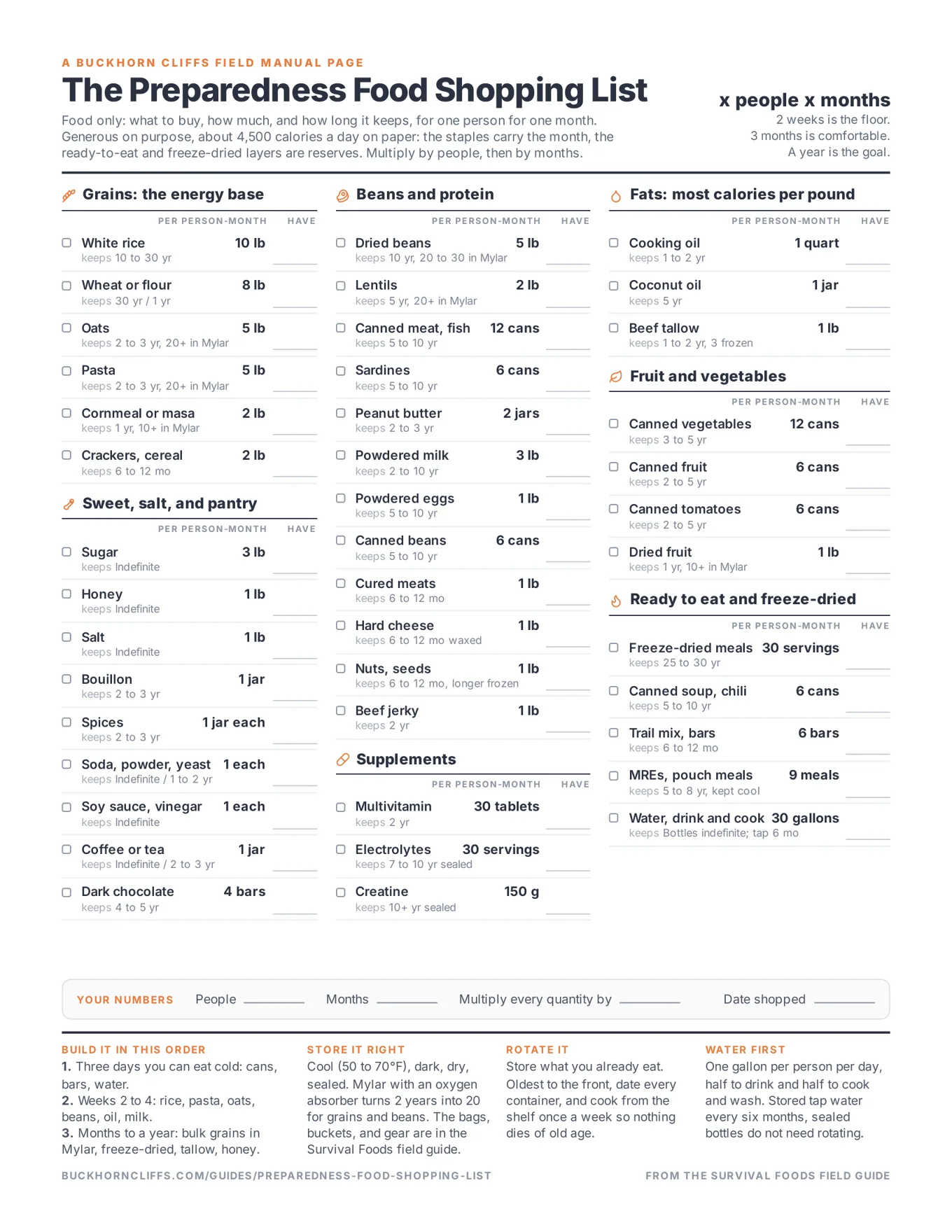
Get the one-page food shopping list
What to store, how much of it for one person for one month, and how long it keeps. One page with checkboxes, built from the Survival Foods field guide. Print it, multiply by your people and months, and take it to the store.
The PDF comes by email, with my newsletter now and then. Already on the list? You still get it. Read the full page.
How to store it
Cool, dark and dry, cans upright and off the floor, because the can is the whole barrier and a rusted or dented can has lost it. Heat is the enemy of the 25 years: a can in a garage at 90°F loses years for every summer. Once opened, press the plastic lid on and keep it dry; the food pulls moisture from the air the moment the seal breaks, which is why an opened can of meat or eggs is a few weeks and an opened can of fruit is a year.
How to tell it has turned
The can first: a bulge, a puncture, a seam dent or rust through the metal means the barrier failed and the contents are suspect. Inside, freeze-dried food should be dry, light and crisp; clumping, softness or stickiness means it has taken on moisture. An off, rancid or stale smell in a fatty food (meat, cheese, eggs) means the oxygen got to it. Faded color alone is age.
Faded color, a can decades past the label that is sound and whose contents are crisp and dry.
A bulged, punctured, seam-dented or rusted-through can; clumped, soft or sticky contents; a rancid smell.
How much, and how to use it
Rehydrate with roughly equal volumes of water for most foods, hot for cooked food and cold for fruit, and wait 5 to 15 minutes. It takes about a cup of water per cup of dry food to come back, which puts it on the water budget: a family living on freeze-dried meals uses a gallon or more of cooking water a day on top of drinking. It cooks with no fuel beyond heating water and no skill, which is the case for it in the first weeks of an outage; the case against it's cost, which is why the buckets of grain and beans carry the months after. The Survival Foods field guide has the full stockpile plan.
When the power goes out
Hot water is all it needs, and cold water works for most of it given time. Count the water. An opened can in a warm house goes faster than the table says; eat from an open can every day until it is empty rather than opening several.
Shelf-life figures are from the Survival Foods field guide; fridge, freezer and pantry times are from the USDA cold and pantry storage charts. Run the look, smell, taste check before eating anything past its date.
Questions this answers
Tap a question for the short answer.
How long does freeze-dried foods last?
Stored well, freeze-dried foods really last 25 to 30 years, even though labels usually say 10 to 25 years. Sealed in Mylar with an oxygen absorber, freeze-dried meals store for 25 years or more.
How do I store freeze-dried foods long term?
A sealed #10 can is the best storage, the very durable commercial long-term standard for freeze-dried and dry goods. Mylar with an oxygen absorber also works, keeping freeze-dried meals for 25 years or more.
How do I tell if freeze-dried foods has gone bad?
Check the packaging for punctures and the contents for moisture. Those are the two things to watch for, because the 25 to 30 year shelf life depends on the container staying sealed.
How long does freeze-dried food last?
Twenty-five to thirty years sealed in a #10 can with an absorber, kept cool and dark, against a label of 10 to 25. Pouches 5 to 30 years by brand. An opened can keeps 6 to 12 months for fruit, vegetables and grains and a few weeks for meat, eggs and dairy.
How do I store freeze-dried food long term?
Sealed cans upright, cool, dark and dry, off the floor, never in a garage or attic. Once opened, lid on and dry, eaten from daily until empty.
How do I tell if freeze-dried food has gone bad?
A bulged, punctured or rusted-through can; contents that have clumped, softened or gone sticky; a rancid smell in meat, cheese or eggs. Faded color alone is age.
How much freeze-dried food do I need?
Count calories, not servings: about 2,000 a day per person. Divide the calories on the can by that to see how many days it really holds, and plan the water, about a cup per cup of dry food.
What I use for this
Gear from my recommended list
Keep going
Related to this
Membership · $49.95 per year
Everything on this site, open, and your own manual that works with no internet
When the grid goes down, this site goes with it. Membership opens every member page and every recipe from the book, hands over all fourteen field guides as PDFs, and gives you your own manual built from the pages your household uses: searchable on your phone with no internet, and printable as one binder.
- 158member pagesopen in full, every amount and every step
- 138compound recipesfrom the hardcover book, exact amounts. Pick any and add them to your manual
- 14field guides313 pages of PDFs, $140 bought one at a time
- 9military field guidesUS Army manuals cut to 66 pages and laid out to use
- Offlineyour own manualbuilt from any page here, searchable on your phone with no internet
- Build your own manual on this site. pick any page, recipe, chart or whole field guide and put them in your order
- Download it and use it with no internet. it opens like an app on your phone or computer, searchable, with no power grid and no signal
- Print it or save it as one PDF. your cover, a contents page and every page you picked, laid out for paper
- All 138 recipes from my hardcover book. exact amounts for pool shock water purification, Lugol's iodine antiseptic, water glassing eggs, laundry powder and the rest
- All 14 field guides, 313 pages. Stockpile Essentials, Survival Foods, Bug-Out Bag, Home Canning, Solar Power and more, to read here or download
- 9 military field guides. Survival, First Aid, Mountaineering and the other US Army manuals, each cut to its most useful pages
- 158 how-to pages in full. medical, hygiene, tools and repair, garden and livestock, food, water and more
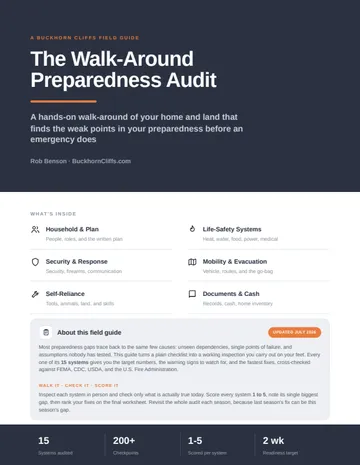
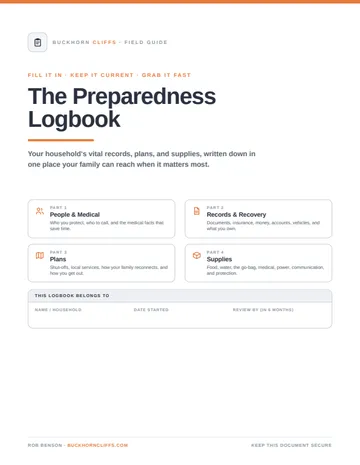
- The audit, the logbook and the checklists. all 200 audit checkpoints, saved to your account on every device
- One payment, $49.95 per year. Cancel any time and keep access to the end of the year you paid for.
- Sign in by email. No password, and the sign-in renews itself on every visit.
- Most of the site stays free. Membership is for the depth, the PDFs and your own offline manual.

Stay Ready
New entries, updates, and useful instruction.
Stay one step ahead on your preparedness journey.