ROOT CELLARWEEKS TO MONTHSETHYLENEWorks without power
Quick facts
- Keeps for months, cool and dark
- Potatoes
- onions
- garlic
- winter squash
- cabbage
- carrots
- beets
- apples
- Keeps for weeks
- Citrus
- pears
- sweet potatoes
- celery
- Days
- Leafy greens
- berries
- tomatoes
- cucumbers
- Watch for
- Soft spots
- mold
- fermented smell
- sprouting
Where this sits on the food shopping list
Fresh produce is the part of a stored-food diet that keeps people healthy and keeps them eating, and more of it keeps without a refrigerator than most kitchens use. The old storage crops, potatoes, onions, squash, cabbage, roots and apples, were bred to sit in a cool cellar from harvest to spring. The rest is days, and belongs in the fridge or in a jar. This page is which is which, and how to keep the keepers.
Which to buy
For storage: firm, unblemished, unwashed, with the stem or the skin intact, bought in season when they are cheapest and freshest. Potatoes and onions that have been stored cold at the store sprout sooner at home. Winter squash with a hard rind and a dry stem. Apples of a storage variety (the tart, firm ones) rather than the soft summer ones. Garlic with tight papery skins. For eating this week, anything; wash it when you use it, not before.
How long it really lasts
By how it is kept
| Form | Label says | Real, stored well |
|---|---|---|
| Potatoes, cool dark and dry (45 to 50°F) | 3 to 5 months; sprout and green in light | |
| Onions and garlic, cool dry and airy | 3 to 6 months; soft and sprouting when done | |
| Winter squash, pumpkins, 50 to 55°F | 3 to 6 months; cured in the sun a week first | |
| Carrots, beets, turnips in damp sand, cold | 3 to 5 months; weeks in the fridge drawer | |
| Cabbage, cold and humid | 2 to 4 months; peel the outer leaves | |
| Apples, cold, away from everything else | 2 to 5 months by variety; a bad apple really does spoil the barrel | |
| Citrus, cool | 3 to 4 weeks; longer refrigerated | |
| Tomatoes, berries, greens, cucumbers | 2 to 7 days; the fridge for greens and berries, never for tomatoes |
Free download
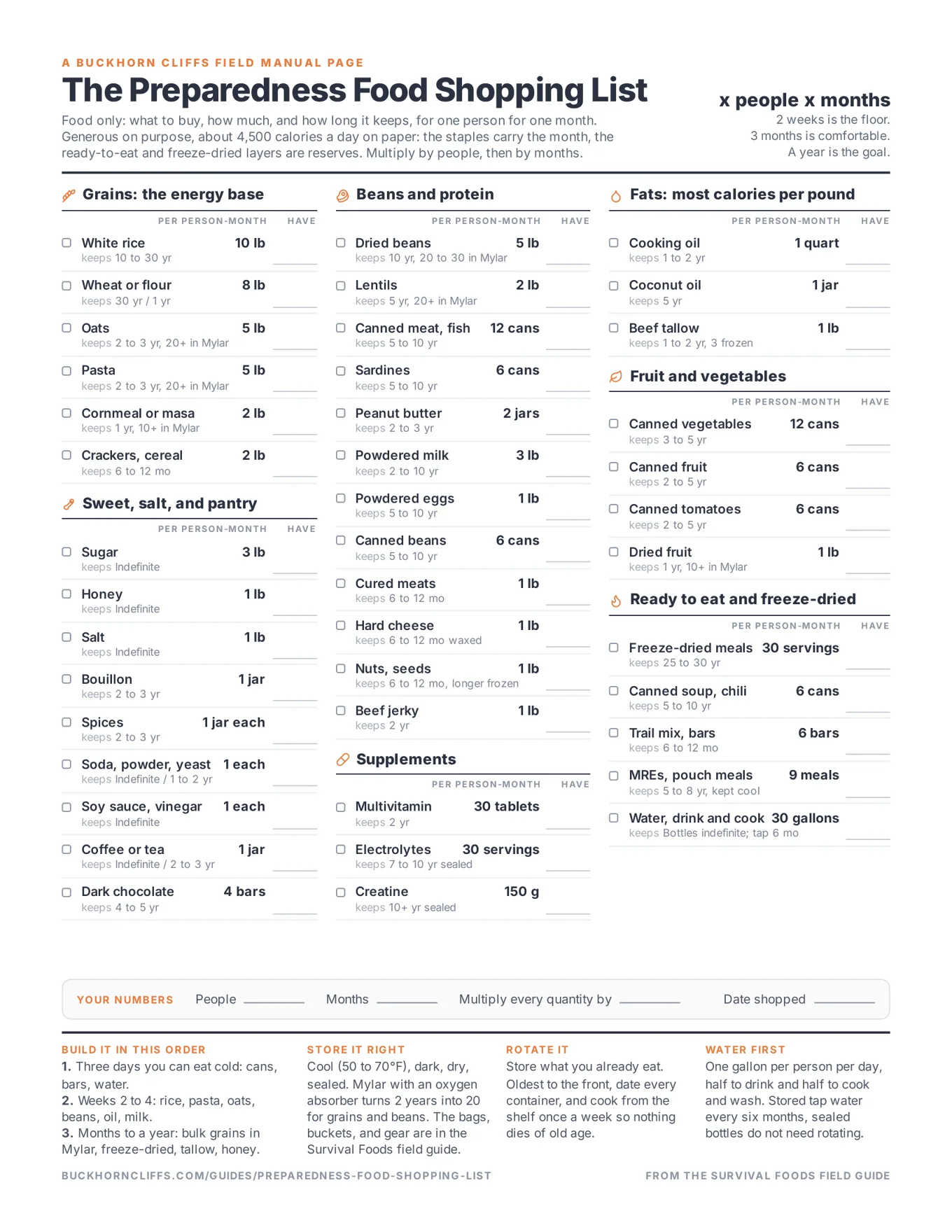
Get the one-page food shopping list
What to store, how much of it for one person for one month, and how long it keeps. One page with checkboxes, built from the Survival Foods field guide. Print it, multiply by your people and months, and take it to the store.
The PDF comes by email, with my newsletter now and then. Already on the list? You still get it. Read the full page.
How to store it
The storage crops want three different rooms: cool, dark and dry for potatoes, onions and garlic (but not together, since onions make potatoes sprout); cold and damp for roots and cabbage, which is a bin of damp sand in the coldest corner of a basement; and cool and dry for squash and pumpkins on a shelf where they do not touch. Apples give off ethylene, the ripening gas, and so do bananas, pears and tomatoes; keep them away from everything you want to last. Check the bins every week and pull anything soft before it spreads. The fridge crisper for greens, berries, celery and anything cut.
How to tell it has turned
Soft spots, wrinkling, mold and a fermented or rotten smell are the signs. A potato that has gone green or sprouted has made solanine; cut away green and sprouts and eat the rest, but a soft, wrinkled, heavily sprouted potato goes to the compost. An onion soft at the neck or with black mold under the skin is done. Squash with a soft spot can be cut, with the spot removed, and cooked that day. Berries with one moldy one go through, the moldy one out, the rest eaten today.
Wrinkled apples, sprouted garlic, a potato with a small green patch cut away, limp carrots revived in cold water.
Soft and leaking, slimy greens, mold on anything soft, a fermented smell, or a potato that is soft and heavily sprouted.
How much, and how to use it
A cellar of potatoes, onions, squash and cabbage is the vitamin C and the bulk that make beans and rice a diet. Eat the short keepers first and the storage crops in order of how they are holding. What will not keep gets preserved: sauerkraut and fermented vegetables, dehydrating, freezing, and canning for the high-acid fruits and pickles. Seeds for next year's storage crops are the long-term plan.
When the power goes out
Fresh produce barely notices an outage. Greens and berries in a warm fridge are a day or two; everything in the cellar carries on. In a long outage the garden and the cellar are the only fresh food there is, which is the reason to know the storage crops before the day you need them.
Shelf-life figures are from the Survival Foods field guide; fridge, freezer and pantry times are from the USDA cold and pantry storage charts. Run the look, smell, taste check before eating anything past its date.
Questions this answers
Tap a question for the short answer.
How do I tell if fresh fruit & veg has gone bad?
Feel for softness or mush, look for mold or rot, and smell for fermentation or off-odors. Soft spots, mold, unusual odors and significant discoloration are the warning signs to watch for.
What fresh vegetables keep without a fridge?
Potatoes, onions, garlic, winter squash, cabbage, carrots, beets and apples, each for months in a cool, dark room with the right humidity: dry for potatoes and onions, damp for roots and cabbage, dry and airy for squash.
How do I store fresh fruit and vegetables long term?
The storage crops go in a cool cellar or basement, roots in damp sand, squash on a shelf, apples away from everything else. The rest is preserved: fermented, dried, frozen or canned.
How do I tell if fresh fruit and vegetables have gone bad?
Soft spots, mold, wrinkling and a fermented or rotten smell. A small green patch or sprout on a potato is cut away; a soft, heavily sprouted potato is composted. Moldy berries are picked out and the rest eaten the same day.
Keep going
Related to this
Membership · $49.95 per year
Everything on this site, open, and your own manual that works with no internet
When the grid goes down, this site goes with it. Membership opens every member page and every recipe from the book, hands over all fourteen field guides as PDFs, and gives you your own manual built from the pages your household uses: searchable on your phone with no internet, and printable as one binder.
- 158member pagesopen in full, every amount and every step
- 138compound recipesfrom the hardcover book, exact amounts. Pick any and add them to your manual
- 14field guides313 pages of PDFs, $140 bought one at a time
- 9military field guidesUS Army manuals cut to 66 pages and laid out to use
- Offlineyour own manualbuilt from any page here, searchable on your phone with no internet
- Build your own manual on this site. pick any page, recipe, chart or whole field guide and put them in your order
- Download it and use it with no internet. it opens like an app on your phone or computer, searchable, with no power grid and no signal
- Print it or save it as one PDF. your cover, a contents page and every page you picked, laid out for paper
- All 138 recipes from my hardcover book. exact amounts for pool shock water purification, Lugol's iodine antiseptic, water glassing eggs, laundry powder and the rest
- All 14 field guides, 313 pages. Stockpile Essentials, Survival Foods, Bug-Out Bag, Home Canning, Solar Power and more, to read here or download
- 9 military field guides. Survival, First Aid, Mountaineering and the other US Army manuals, each cut to its most useful pages
- The Old Library, to print and keep. print any of 4,941 articles from the 1911 Britannica and two old formula books, or save them to My Manual
- 158 how-to pages in full. medical, hygiene, tools and repair, garden and livestock, food, water and more
- The audit, the logbook and the checklists. all 200 audit checkpoints, saved to your account on every device
- One payment, $49.95 per year. Cancel any time and keep access to the end of the year you paid for.
- Sign in by email. No password, and the sign-in renews itself on every visit.
- Most of the site stays free. Membership is for the depth, the PDFs and your own offline manual.







Stay Ready
New entries, updates, and useful instruction.
Stay one step ahead on your preparedness journey.