WHOLE GRAIN 30 YRFLOUR 1 YRMILL ITWorks without power
Quick facts
- Whole grains, sealedWheat berries, white rice, corn: 20 to 30 years in Mylar
- White flour6 to 12 months on the shelf; years sealed with an absorber
- Whole wheat flour, cornmeal, brown rice3 to 6 months on the shelf; the germ oil turns
- Watch for
- Weevils
- webbing
- clumping
- a musty or rancid smell
Where this sits on the food shopping list
A whole grain is a seed, sealed by nature, and it keeps for decades. Flour is that seed broken open, and the clock starts the day it's milled: white flour, with the oily germ removed, lasts a year on the shelf; whole wheat flour and cornmeal, germ included, a few months before they go bitter. That one fact organizes the whole grain store: keep the grain whole, keep a mill, and keep only the flour you will use this season. The details for the two biggest are on the white rice and wheat berries pages.
Which to buy
For the deep store: hard red or hard white wheat berries, white rice, field corn or popcorn (for cornmeal), and rolled oats, in 25 and 50 pound bags from a bulk or restaurant supplier, packed the week they come home. For the working pantry: white all-purpose and bread flour in the 10 pound bag, replaced as used, and small bags of whole wheat flour and cornmeal kept in the freezer. A hand grain mill is the piece of equipment that makes the whole-grain store usable without power.
How long it really lasts
By how it is kept
| Form | Label says | Real, stored well |
|---|---|---|
| Wheat berries, white rice, field corn, in Mylar with an absorber | 6 months to 2 years | 20 to 30 years |
| Same grains in the original bag, cool and dry | 1 to 2 years before bugs and staleness | |
| White flour, all-purpose or bread | 6 to 12 months | 6 to 12 months on the shelf; a year refrigerated; years sealed with an absorber |
| Whole wheat flour | 3 to 6 months | 6 to 8 months on the shelf; a year frozen |
| Cornmeal, whole grain | Months on the shelf; a year frozen; degerminated cornmeal about a year | |
| Brown rice, other high-oil grains | About a year; not a long-term food | |
| Rolled oats, barley, millet, quinoa, sealed | 1 to 2 years | 2 to 3 years airtight; longer in Mylar |
Free download
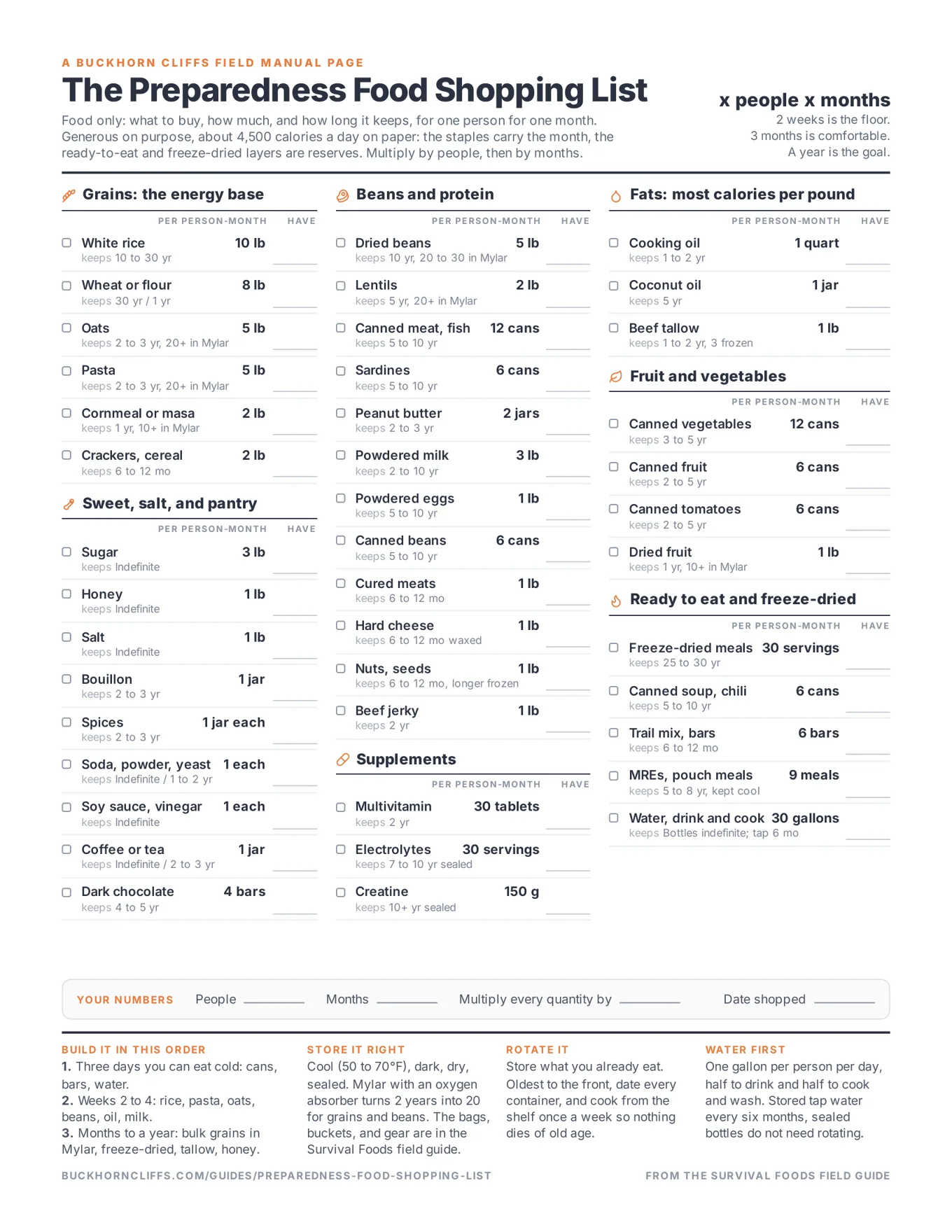
Get the one-page food shopping list
What to store, how much of it for one person for one month, and how long it keeps. One page with checkboxes, built from the Survival Foods field guide. Print it, multiply by your people and months, and take it to the store.
The PDF comes by email, with my newsletter now and then. Already on the list? You still get it. Read the full page.
How to store it
Cool, dark and dry, in something airtight. The original bag or box is fine for the months you will use it in; for the years, the answer is the same as for rice: a Mylar bag with an oxygen absorber inside a food-grade bucket, which keeps out oxygen, moisture, light and every insect egg that came home from the mill. The Mylar ranking says which foods take an absorber and which do not.
Flour is the one that disagrees: it's fine in Mylar with an absorber for the long term, but the bag you bake from lives in an airtight canister or the freezer. Whole wheat flour and cornmeal go in the freezer from the day they come home. Freezing any grain or flour for four days at 0°F kills the weevil eggs that came from the mill; let it come to room temperature sealed before it goes into a bucket.
How to tell it has turned
Weevils are small dark beetles; their sign in flour is clumping, a gray cast, and webbing from the moths that follow. The grain or flour goes and the shelf gets cleaned. A musty smell is moisture and mold is next. Whole wheat flour, cornmeal and brown rice that smell bitter, sharp or like old paint have gone rancid; they are not dangerous in a loaf but they taste of it. Whole grains that are dry and clean smelling are fine at any age; a sample that sprouts or grinds to a sweet-smelling flour is proof.
Old whole grains that are dry and clean smelling; white flour that has gone a little flat; clumps that break up with a spoon.
Weevils, webbing, a gray cast with clumps, a musty smell or mold, or whole grain flour and cornmeal that smell rancid.
How much, and how to use it
Grain is the calorie base: about 1,600 calories a pound dry for wheat, rice and corn. The field guide's planning numbers come to roughly 40 to 45 pounds of dry staples per person per month, most of it grain. A hand mill turns a cup of wheat berries into a cup and a half of flour in a few minutes, and fresh flour bakes bread, flatbread, pancakes and the hardtack that keeps. Whole wheat berries also cook like rice (soaked, then simmered an hour) and sprout in a jar in three days for the green vegetable a winter store lacks.
When the power goes out
Whole grains and the hand mill are the no-power bakery. Flour in the freezer thaws and is fine; use it first. A skillet flatbread on a camp stove needs flour, water, salt and ten minutes, which is the bread recipe to learn before the day you need it.
Shelf-life figures are from the Survival Foods field guide; fridge, freezer and pantry times are from the USDA cold and pantry storage charts. Run the look, smell, taste check before eating anything past its date.
Questions this answers
Tap a question for the short answer.
How do I tell if grains & flours has gone bad?
Warning signs are mold, moisture, off-odors, or pests like weevils. Look for discoloration, clumping, or small bugs, and smell for mustiness or unusual odors.
How long do grains and flours last?
Whole grains sealed in Mylar with an oxygen absorber keep 20 to 30 years; in the bag, 1 to 2 years. White flour 6 to 12 months on the shelf and years sealed with an absorber. Whole wheat flour and whole-grain cornmeal a few months on the shelf and a year frozen. Brown rice about a year.
How do I store flour long term?
White flour in Mylar with an oxygen absorber inside a bucket keeps for years; the working bag lives in an airtight canister or the freezer. Whole wheat flour and cornmeal go in the freezer because the germ oil turns. For the decades store, keep the grain whole and mill it as needed.
How do I tell if grains and flours have gone bad?
Weevils, webbing, clumping with a gray cast, a musty smell or mold. Whole wheat flour, cornmeal and brown rice that smell bitter or like old paint are rancid. Dry, clean-smelling whole grain is fine at any age.
Why do whole grains keep longer than flour?
The grain is a sealed seed with its oil locked inside the germ. Milling breaks it open and exposes the oil to air, and the oil goes rancid in months. White flour has the germ removed, which is why it keeps a year; whole wheat flour keeps the germ and keeps months.
Keep going
Related to this
Membership · $49.95 per year
Everything on this site, open, and your own manual that works with no internet
When the grid goes down, this site goes with it. Membership opens every member page and every recipe from the book, hands over all fourteen field guides as PDFs, and gives you your own manual built from the pages your household uses: searchable on your phone with no internet, and printable as one binder.
- 158member pagesopen in full, every amount and every step
- 138compound recipesfrom the hardcover book, exact amounts. Pick any and add them to your manual
- 14field guides313 pages of PDFs, $140 bought one at a time
- 9military field guidesUS Army manuals cut to 66 pages and laid out to use
- Offlineyour own manualbuilt from any page here, searchable on your phone with no internet
- Build your own manual on this site. pick any page, recipe, chart or whole field guide and put them in your order
- Download it and use it with no internet. it opens like an app on your phone or computer, searchable, with no power grid and no signal
- Print it or save it as one PDF. your cover, a contents page and every page you picked, laid out for paper
- All 138 recipes from my hardcover book. exact amounts for pool shock water purification, Lugol's iodine antiseptic, water glassing eggs, laundry powder and the rest
- All 14 field guides, 313 pages. Stockpile Essentials, Survival Foods, Bug-Out Bag, Home Canning, Solar Power and more, to read here or download
- 9 military field guides. Survival, First Aid, Mountaineering and the other US Army manuals, each cut to its most useful pages
- 158 how-to pages in full. medical, hygiene, tools and repair, garden and livestock, food, water and more
- The audit, the logbook and the checklists. all 200 audit checkpoints, saved to your account on every device
- One payment, $49.95 per year. Cancel any time and keep access to the end of the year you paid for.
- Sign in by email. No password, and the sign-in renews itself on every visit.
- Most of the site stays free. Membership is for the depth, the PDFs and your own offline manual.









Stay Ready
New entries, updates, and useful instruction.
Stay one step ahead on your preparedness journey.