30 YRMILL ITCALORIE BASEWorks without power
Quick facts
- Real shelf lifeUp to 30 years in Mylar with an absorber
- Label date says6 to 8 months
- Best storage
- Mylar
- absorber
- bucket
- cool
- dark
- Watch for
- Weevils
- moisture
- a musty smell
Where this sits on the food shopping list
Wheat berries are whole wheat kernels, the seed with nothing removed, and they are the longest-keeping calorie there is: up to 30 years sealed in Mylar with an oxygen absorber. Flour goes stale in months; the berry it came from waits for decades. The catch is that a bucket of wheat is not food until it's milled, cooked or sprouted, so this page is as much about the mill as the grain.
Which to buy
Hard red winter wheat is the traditional bread wheat, high protein, strong flavor. Hard white wheat bakes the same loaf with a milder taste that people used to store flour accept more easily, and it's the one to buy if you are starting. Soft white wheat is for pastry, biscuits and crackers, lower in protein. Buy cleaned, dry grain (under 10 percent moisture) from a food-storage supplier or a farm, in 25 to 50 pound bags, and pack it the week it arrives. Then buy the mill: a hand mill with steel or stone burrs that will grind fine flour without electricity, and an electric one if you want speed while the grid is up.
How long it really lasts
By how it is kept
| Form | Label says | Real, stored well |
|---|---|---|
| Wheat berries, Mylar with oxygen absorber, cool | 6 to 8 months | Up to 30 years |
| Wheat berries, sealed bucket, no absorber | 5 to 10 years; bugs and staleness end it | |
| Wheat berries, original bag | 1 to 2 years | |
| Fresh-milled whole wheat flour | Days at room temperature at full flavor; weeks refrigerated; a year frozen | |
| Cooked wheat berries, refrigerated | 4 to 5 days |
Free download
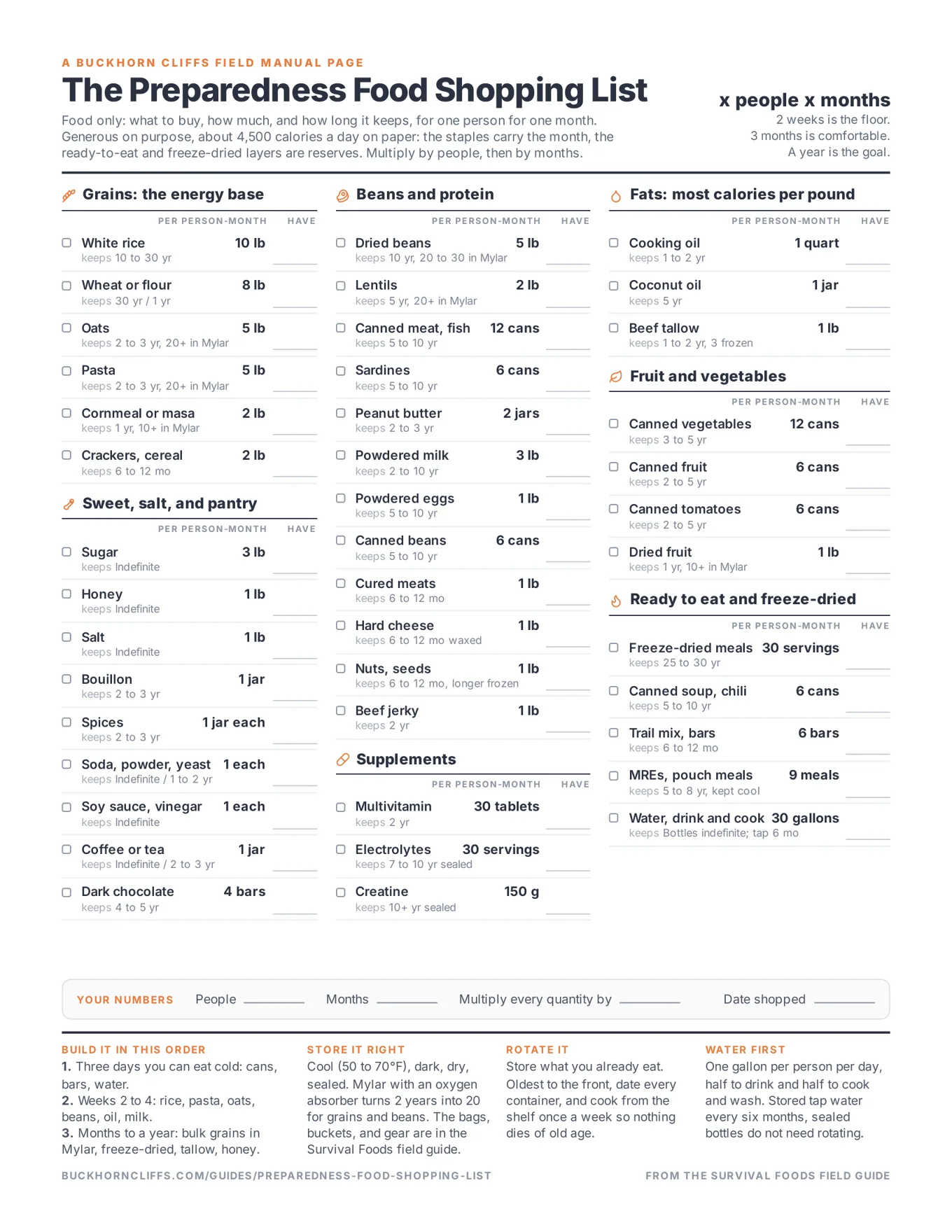
Get the one-page food shopping list
What to store, how much of it for one person for one month, and how long it keeps. One page with checkboxes, built from the Survival Foods field guide. Print it, multiply by your people and months, and take it to the store.
The PDF comes by email, with my newsletter now and then. Already on the list? You still get it. Read the full page.
How to store it
Cool, dark and dry, in something airtight. The original bag or box is fine for the months you will use it in; for the years, the answer is the same as for rice: a Mylar bag with an oxygen absorber inside a food-grade bucket, which keeps out oxygen, moisture, light and every insect egg that came home from the mill. The Mylar ranking says which foods take an absorber and which do not.
A 5 gallon bucket holds about 35 pounds of wheat with a 2000 cc absorber. Mill only what you will bake with in a week or two; fresh whole wheat flour has the germ oil in it and begins to turn in days at room temperature. Freezing the grain for four days before packing kills weevil eggs if you skip the absorber.
How to tell it has turned
Weevils are small dark beetles that bore out of the kernel, leaving a hole; their sign is holes, dust and webbing, and a buggy bag goes. Moisture shows as clumping, a musty smell, and mold. Sound wheat is hard, dry, and smells faintly sweet when a handful is crushed; a few kernels put on a damp towel will sprout in two days, which is the proof that a decades-old bucket is still alive and good.
Dry, clean-smelling grain at any age; grain that sprouts on a damp towel; faded color.
Holes, dust and webbing from weevils, clumping, a musty smell, or mold.
How much, and how to use it
A pound of wheat is about 1,500 calories and 60 grams of protein, and it is the calorie base of the field guide's 40 to 45 pounds of dry staples per person per month. A cup of berries mills into about a cup and a half of flour. Fresh whole wheat flour makes bread, flatbread, pancakes and hardtack; it absorbs more water than white flour and needs a little more of it. The berries also cook whole, soaked overnight and simmered about an hour, into a chewy grain that stands in for rice, and sprout in a jar in three days into a green vegetable with vitamin C the dry store lacks. Cracked in the mill on a coarse setting they are a hot cereal.
When the power goes out
A hand mill and a camp stove turn a bucket of wheat into bread with no electricity. Fifteen minutes of grinding is a loaf's worth of flour; it's real work, which is the argument for an electric mill while the power is on and a hand mill for when it's not. Sprouting needs nothing but a jar and water.
Shelf-life figures are from the Survival Foods field guide; fridge, freezer and pantry times are from the USDA cold and pantry storage charts. Run the look, smell, taste check before eating anything past its date.
Questions this answers
Tap a question for the short answer.
How long does wheat berries last?
Wheat berries last up to 30 years when stored well, even though the label date says 6 to 8 months. That lifespan depends on Mylar with an oxygen absorber and cool storage.
How do I store wheat berries long term?
Clean, dry grain in Mylar with a 2000 cc absorber inside a 5 gallon bucket, about 35 pounds, cool and dark. Mill it as you bake; do not store the flour.
How do I tell if wheat berries has gone bad?
Warning signs are mold, moisture, off-odors, or pests like weevils. Look for discoloration, clumping, or small bugs, and smell for mustiness or unusual odors.
How long do wheat berries last?
Up to 30 years sealed in Mylar with an oxygen absorber and kept cool, against a label of 6 to 8 months; 5 to 10 years in a sealed bucket without an absorber; 1 to 2 years in the bag. Fresh-milled flour turns in days.
How do I tell if wheat berries have gone bad?
Holes, dust and webbing from weevils, clumping or a musty smell from moisture, or mold. Sound wheat is hard, dry and sweet-smelling, and sprouts on a damp towel.
What kind of wheat berries should I store?
Hard white wheat for bread with a mild taste, hard red for the traditional loaf, soft white for pastry and crackers. All store the same; buy cleaned grain under 10 percent moisture.
Keep going
Related to this
Membership · $49.95 per year
Everything on this site, open, printable, and yours on paper
When the grid goes down, this site goes with it. Paper does not. Membership opens every member page and every recipe from the book, hands over all thirteen field guides as PDFs, and builds a binder from the pages your household uses.
- 158member pagesopen in full, every amount and every step
- 138compound recipesfrom the hardcover book, exact amounts. Pick any and add them to your manual
- 13field guides304 pages of PDFs, $130 bought one at a time
- 9military field guidesUS Army manuals cut to 66 pages and laid out to use
- 1manual of your ownbuilt from any page here, printed with your cover
- Every member page in full. the exact amounts, every step, every parts list
- Every recipe and resource from the book. all 138 from the Prepper's Chemical Survival Guide, searchable here
- All 13 field guides. read them here or download the PDFs, 304 pages
- A field guide for each of 9 Army manuals. the survival, first aid and other US Army manuals, each cut to 10 pages or fewer
- My Manual. save any page, recipe or whole guide, order it, print one binder with your own cover
- The audit and the logbook, saved. your scores and checklists on every device
- Print and Save as PDF on every page. and no ads
- One payment, $49.95 per year. Cancel any time and keep access to the end of the year you paid for.
- Sign in by email. No password, and the sign-in renews itself on every visit.
- Most of the site stays free. Membership is for the depth, the PDFs and the paper.








Stay Ready
New entries, updates, and useful instruction.
Stay one step ahead on your preparedness journey.