Quick facts
- Box
- Milwaukee PACKOUT Deep Organizer
- IP65 sealed
- stacks with the tool boxes
- WaterGrayl GeoPress Titanium: press to purify 24 oz in about 8 seconds, boil in the outer cup
- FireBlack Beard Lifeline fire kit with lighters and waterproof matches as backups
- BleedingCAT tourniquet and Israeli bandage, on top where you can reach them
- ContactRocky Talkie FRS in a Faraday bag; the 5 watt GMRS lives in the truck
- Not in the boxTools. A hatchet, a shovel and the tool kit ride in the vehicle
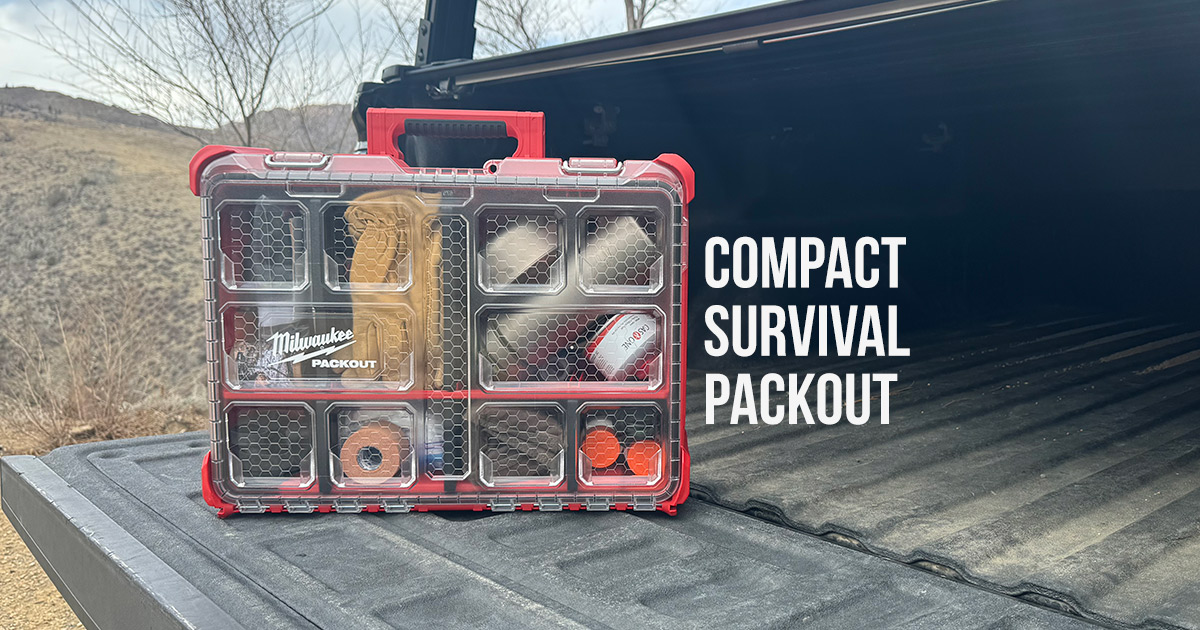
This is the box that rides behind the seat of the truck, sits on the table at camp, and comes into the house when the power goes out. It is not a tool kit; the hatchet, the shovel and the wrenches have their own boxes and the car kit covers the recovery gear. This box covers the other problems: making water safe, making fire, cooking, finding the way, stopping bleeding, reaching people and fixing what breaks. Everything in it is packed by the problem it solves, so I can find it in the dark, and everything in it is something I have used.
The bug-out bag overlaps this list a great deal. The difference is that the bag is packed for weight on your back, and this box is packed for reach at the vehicle.
The box
Milwaukee PACKOUT Deep Organizer
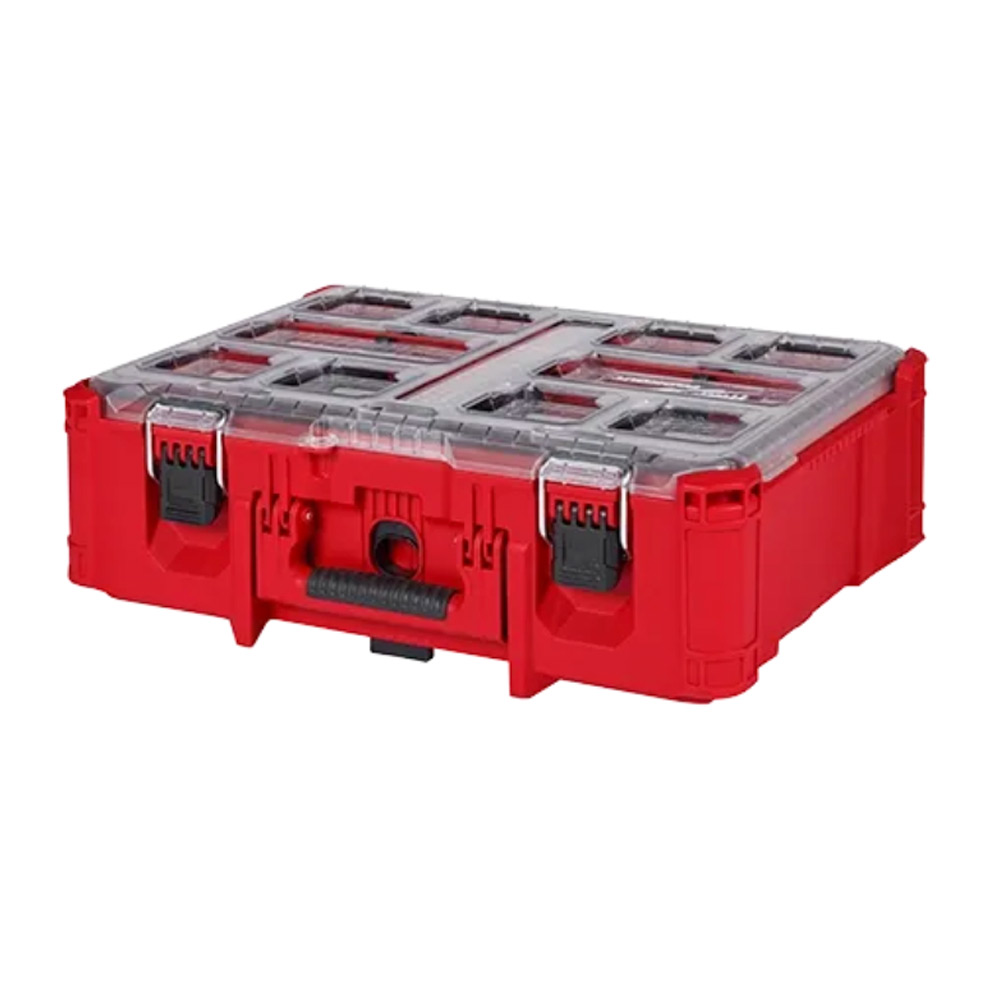
The boxAn impact resistant polymer box with an IP65 weather seal, a clear lid and removable bins, and it locks onto the PACKOUT tool boxes already in the truck. The bins matter: the trauma gear gets its own, so it comes out as a unit, and the small items stay sorted instead of drifting to the bottom. A soft bag hides its contents and gets crushed; this stacks, seals and opens flat.
Water
Grayl GeoPress Titanium purifier bottle
Water · purifies, not just filtersMost filter bottles stop bacteria and protozoa and let viruses through. The GeoPress purifies: viruses, bacteria and protozoa, and it reduces heavy metals, pesticides and chemicals, with a press that takes about 8 seconds for 24 ounces. The titanium version adds a second method: pull the inner press and cartridge out and the outer cup goes next to coals or on the stove to boil. Two ways to make water safe in one bottle, and it is the bottle I drink from anyway. The clean water guide covers what each method handles.
Electrolytes and salt in pill bottles
Water · two supplement bottlesSweat takes salt with the water, and on a hot day of work or a long walk, water alone brings on the cramps and the headache. I keep Cardnl zero sugar electrolyte powder in one emptied supplement bottle and Redmond Real Salt in another; the bottles are waterproof, they fit a bin, and the salt keeps forever. A pinch of salt in a bottle of water is the oldest electrolyte drink there is. Salt for survival covers every other use, and the pill bottle kit is the same idea taken further.
Free download
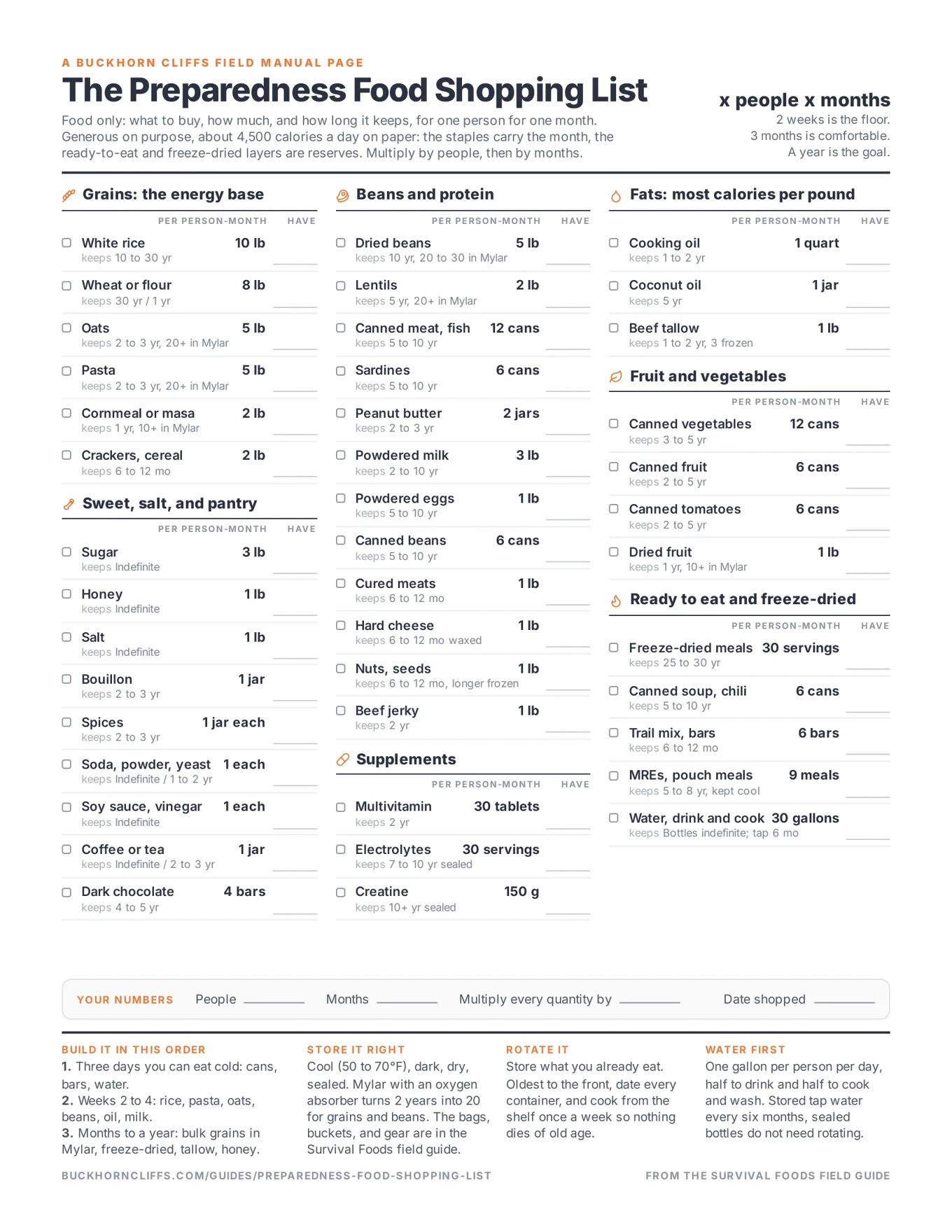
Get the one-page food shopping list
What to store, how much of it for one person for one month, and how long it keeps. One page with checkboxes, built from the Survival Foods field guide. Print it, multiply by your people and months, and take it to the store.
The PDF comes by email, with my newsletter now and then. Already on the list? You still get it. Read the full page.
Fire and cooking
Black Beard Lifeline fire kit, lighters, waterproof matches
Fire · three ways to lightThe Lifeline kit, which Black Beard used to call the Do-All kit, is a ferro rod, a striker and their fire rope, which lights wet and burns long enough to dry kindling. Two lighters and a tin of waterproof matches ride beside it, because the ferro rod is the one that always works and the lighter is the one you reach for first. Three ways to light, in one bin, with tinder that does not care about rain. Fire making techniques is the how.
Titanium pocket stove and dining set
Cooking · nests inside the GraylA 28 gram titanium canister stove that screws onto an isobutane can and boils water in a few minutes, with a flame you can turn down to simmer. It nests inside the Grayl cup with a small canister, so the water and the stove are one unit. A titanium bowl, plate and spork weigh nothing, take direct heat, and clean with a wipe. Freeze dried food, coffee and soup are all just hot water, and hot water is what this makes.
Bleeding, injury and cold
The trauma gear sits in the top bin, where someone who has never seen the box could find it. Take a Stop the Bleed class; it takes about 90 minutes, usually free, and it is the difference between owning a tourniquet and being able to use one. The medical preparedness guide covers the full kit and the training.
CAT tourniquet and Israeli bandage
Bleeding · the two that stop a deathA CAT tourniquet goes on one-handed, high and tight on the limb, and the windlass locks; it stops arterial bleeding from an arm or a leg in under a minute. The Israeli bandage is a sterile pad, an elastic wrap and a pressure bar in one vacuum sealed package, for the wounds a tourniquet cannot reach and for holding pressure without a second person. Buy the real ones; the counterfeit tourniquets on the big marketplaces break at the windlass.
Leukotape P and non-adherent dressings
Injury · the tape that stays onLeukotape is a rigid, aggressive sports tape that stays on wet skin for days: it stops a hot spot from becoming a blister, splints a sprained ankle well enough to walk out, and holds a dressing through a day of work. Non-adherent dressings cover burns and scrapes without tearing the wound open at the next change. Together with the tourniquet and bandage they are the small kit that handles most of what actually happens.
Mylar blankets
Cold · shock, wind, signalTwo of them. A Mylar blanket reflects most of the body heat that would otherwise radiate away, keeps the wind and rain off, and wrapped around an injured person it is the first treatment for shock. Shiny side out it is a signal panel. They weigh an ounce and tear if you look at them wrong, so carry two.
Leather gloves, fixed blade, multi-tool
Hands · the tools that stay in the boxLeather gloves for firewood, hot pots, wire and rope. A small fixed blade, the Toor Mullet in CPM 154 with a Kydex sheath, for food, tinder and cutting cord; a fixed blade has no hinge to fail and cleans in a creek. A multi-tool for the pliers and the screwdrivers. These three are the exception to the no-tools rule because a kit without a knife is not a kit.
Contact and power
Rocky Talkie FRS radios, in a Faraday bag
Contact · the groupTwo 2 watt FRS handhelds, no license needed, with a realistic 1 to 5 miles in open mountains and half a mile to 3 miles in timber; the 35 mile number on the box is line of sight from one peak to another. Three days on a charge, weatherproof, and a carabiner clip that survives being dropped. They live in a Faraday bag inside the box, which also holds a spare phone and keeps both from the rare event that takes out electronics. The 5 watt GMRS radio stays in the truck for range and repeaters; GMRS versus FRS explains the choice, and the Faraday bag guide covers what the bag does and does not do.
Power bank and cables
Power · phones, radios, headlampA slim 5,000 mAh magnetic power bank with a fold-out stand charges a phone once and the radios or the headlamp several times, and takes no space in a bin. A short USB-C cable and a short Lightning cable, coiled with a rubber band, and a wall cube for when there is an outlet. The big power bank and the solar panel are in the outage kit; this is the one that is always in the truck.
Repairs and rigging
Folding saw and pocket chainsaw
Repairs · woodA folding saw with a locking SK-5 blade cuts firewood, clears a limb off the road and notches a shelter pole; it is safer and faster than a hatchet for anything under wrist thick. The pocket chainsaw, a length of chain with two paracord handles, takes down a bigger limb from the ground and weighs a few ounces. The hatchet is in the truck, not the box.
Paracord, Gorilla tape, rubber bands, carabiners
Repairs · everything elseA hundred feet of 750 paracord, which is 550 cord with more inner strands and a higher break; a tarp ridgeline, a bear hang, a boot lace, a splint tie. Wide Gorilla tape, wrapped around a bottle so it takes no room, for tents, hoses, blisters and broken things. Heavy rubber bands for bundling and for holding a dressing when the tape is gone. Four real carabiners, rated ones, for hanging gear and rigging a line; the keychain kind break when it matters. The knots guide is what turns the cord into a shelter.
MODL Infinity ToolKit
Repairs · modular strapsA set of silicone loops and studs that link into straps, lashings, hangers and handles in any length. It replaces the pile of bungees and Velcro straps that used to live in the box: lashing a saw to a pack, hanging a lantern, holding the lid of a bin, tying a load to the rack. The pieces are weather resistant and they stretch enough to hold and not enough to slip.
Heavy duty sewing kit
Repairs · fabricCurved and straight needles, an upholstery needle, waxed thread and a thimble. A torn pack strap, a ripped tent fly, a boot seam or a jacket that lets the wind in is a ten minute repair with the right needle and no repair at all without it.
Survival fishing kit
Food · when the trip goes longHooks, line, sinkers and a few small lures in a tin the size of a deck of cards. A hand line off a stick catches trout in a mountain creek if you are patient. It is the lightest food source in the box, and it goes in every kit I build.
The checklist
Top bin: bleeding and cold
- CAT tourniquet
- Israeli bandage
- Leukotape P, non-adherent dressings
- Two Mylar blankets
- Leather gloves
Water, fire, cooking
- Grayl GeoPress Titanium
- Electrolytes and salt in pill bottles
- Fire kit, two lighters, waterproof matches
- Titanium stove and one isobutane canister
- Titanium bowl, plate, spork
Navigation and contact
- Compass, county maps
- Kestrel, monocular, rangefinder
- Headlamp, charged
- Two FRS radios and spare phone in Faraday bag
- Power bank, cables, wall cube
Repairs
- Fixed blade, multi-tool
- Folding saw, pocket chainsaw
- Paracord, Gorilla tape, rubber bands, carabiners
- MODL straps, sewing kit, fishing kit
Twice a year: charge the radios, the headlamp and the power bank, check the dates on the dressings, replace the lighters, and put back whatever got borrowed. A kit that has been raided for camping is a box of empty bins.
Questions this answers
Tap a question for the short answer.
What should I put in a grab and go kit?
Pack by problem, not by product. Water: a purifier bottle, electrolytes and salt. Fire and food: a fire kit with three ways to light, a pocket stove and a titanium bowl and spork. Navigation: compass, paper maps, a monocular, a headlamp. Bleeding and injury: a tourniquet, an Israeli bandage, rigid tape, non-stick dressings, a Mylar blanket. Contact and power: FRS radios in a Faraday bag, a power bank and cables. Repairs: paracord, tape, a folding saw, a sewing kit, carabiners, rubber bands. Knives and a multi-tool ride in the box; the rest of the tools do not.
What is the best container for a preparedness kit?
A hard, sealed, stackable box you can carry one-handed and see into. I use the Milwaukee PACKOUT Deep Organizer: an IP65 weather seal, removable bins so the trauma gear has its own compartment, a clear lid, and it locks onto the PACKOUT tool boxes in the truck. A soft bag hides what is in it and crushes what is under it.
What water filter bottle should I keep in my kit?
One that purifies, not just filters. The Grayl GeoPress removes viruses as well as bacteria and protozoa, and cuts heavy metals and chemicals, in one press that takes about 8 seconds for 24 ounces. The titanium version has an outer cup you can set next to coals to boil water once the inner press and cartridge are pulled out, which is a second purification method in the same bottle.
What non-tool items belong in a vehicle emergency kit?
Everything on this page: a way to make water safe, three ways to make fire, a stove and something to eat from, a compass and a light, a tourniquet and a pressure bandage, a radio and a power bank, and cordage and tape for repairs. The tools, a hatchet, a shovel, a jump starter and a recovery rope, are in the car kit guide and ride in the vehicle separately.
How do I carry salt and electrolytes in a kit?
In two emptied supplement bottles with the labels replaced: one of electrolyte powder, one of unrefined salt. The bottles are waterproof, they fit in a bin, and the salt keeps forever. Sweat takes salt as well as water; on a hot day of work or a long walk, water alone is not enough and the cramps and the headache are the warning.
What first aid goes in a grab and go kit?
Start with the things that stop a death: a CAT tourniquet and an Israeli pressure bandage, on top of the box where a stranger could find them. Then Leukotape for blisters, sprains and holding dressings, non-adherent dressings for burns and scrapes, and a Mylar blanket for shock and cold. Take a Stop the Bleed class so the tourniquet gets used right; it is a 90 minute course and it is usually free.
What is the difference between a grab and go kit and a bug out bag?
The grab-and-go kit is a box that lives in the truck or on the camp table and covers problems at or near the vehicle. The bug-out bag is a backpack built to carry you away from the vehicle for three days on foot. There is a lot of overlap in what goes in each; the difference is that the bag is packed for weight and the box is packed for reach.
Keep going
Related to this
Membership · $49.95 per year
There is a lot more behind the lock
Every recipe and resource from the Prepper's Chemical Survival Guide, all six field guides to read here and download, the full audit and logbook, all twelve reference charts, and no ads.
My Manual · included
Build your own field manual
The most useful thing a membership gives you. Save any page on this site, recipes, charts, and whole field guides included. Arrange them in the order you want, name it, and print one manual with a cover and contents, or keep it as a PDF that opens with no signal.
- It works when this site does not
- Only your pages
- Anyone in the house can use it
- One current copy, not a pile of printouts
- The house binder
- A copy for the bug-out bag or truck
- A copy for family
- An offline PDF






Stay Ready
New entries, updates, and useful instruction.
Stay one step ahead on your preparedness journey.