Quick facts
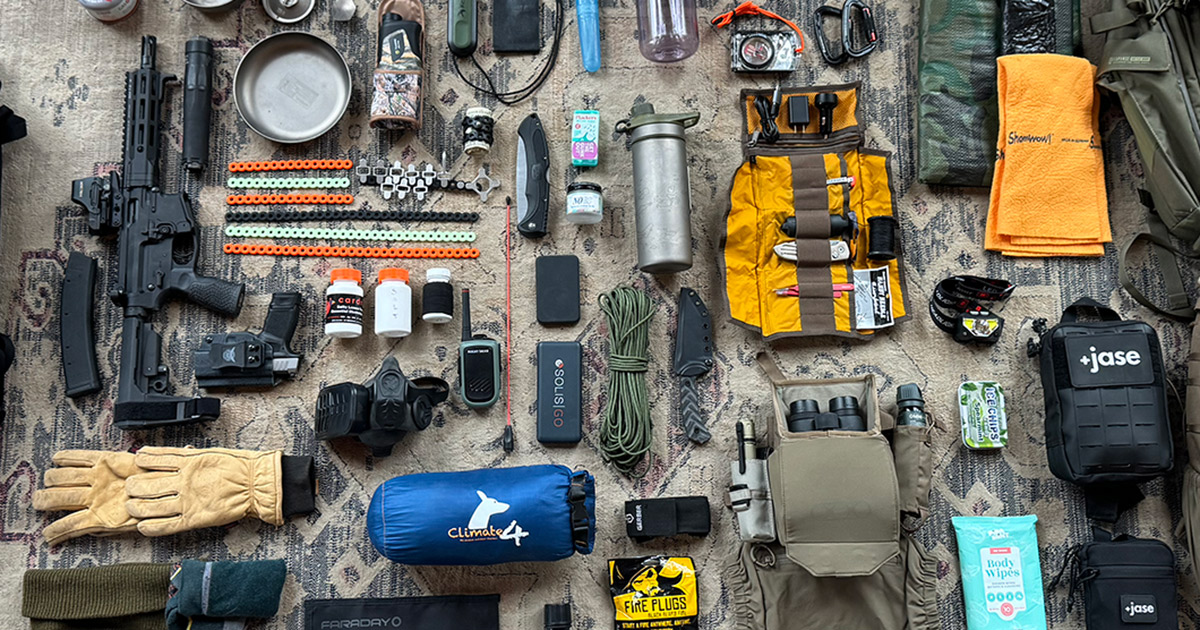
- PacksEberlestock Switchblade (pistol), Fade Adapt (carbine), GRAYL Transport EXP 30L (waterproof)
- BleedingJaseAid trauma kit on top, JaseAid mini kit for everything else
- Water and cooking
- GeoPress Ti purifier
- 28 gram titanium stove
- 100 g isobutane
- Contact5 watt GMRS Rocky Talkie with whip antenna, Solis hotspot, Faraday phone bag
- Warmth
- Down blanket rated to 32°F
- 8 by 10 tarp
- wool hat
- socks
- Cash
- $300 in ones
- fives
- twenties
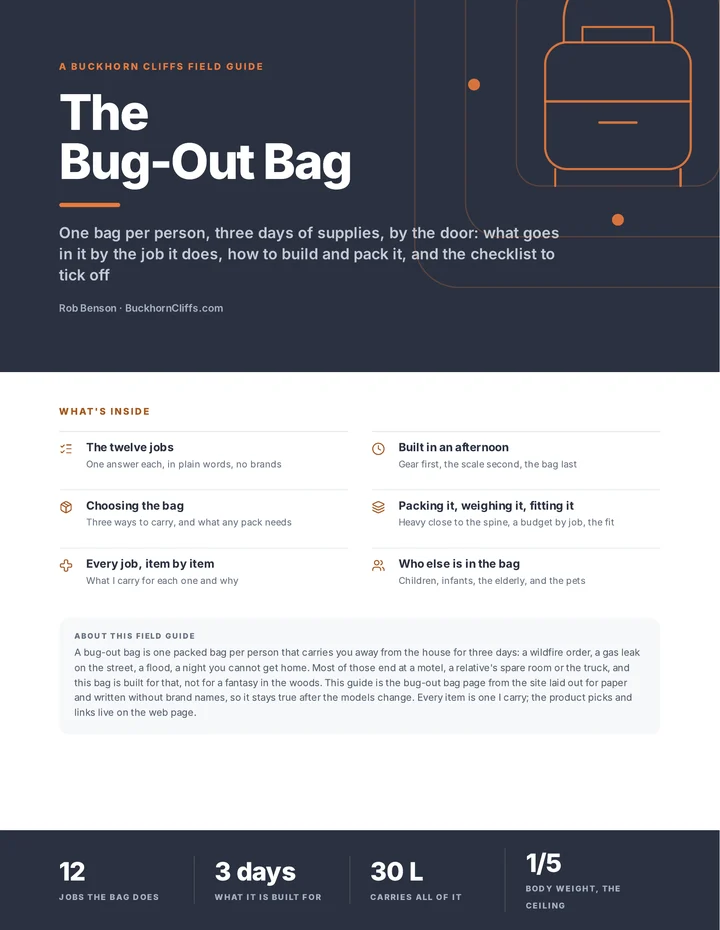
A bug-out bag is one packed bag per person, ready by the door, that carries you away from the house for three days: a wildfire evacuation order, a gas leak on the street, a flood, a night you cannot get home. The bag is packed for weight on your back; the grab-and-go box is packed for reach at the truck, and the car kit covers the vehicle itself. They overlap on purpose. Most evacuations end in a motel, a relative's spare room or the truck, and this bag is built for that, not for a fantasy in the woods; why bugging out early is a mistake is the honest version of when it gets used.
Everything below is packed by the problem it solves, and every item is one I carry. Where I link a product it is the one in my bag.
This is the Bug-Out and Go-Bags page of the Stockpile Essentials field guide. Buy in this order and build out from there.
- Waterproof bag
- Mylar blankets
- Multitool
- Ferro rod
- Fixed blade knife
- Headlamp
- Hatchet
- Paracord
- Duct tape
- Zip ties
- Carabiners
- Towel
- Compass
- GMRS radio
- Solar charger
- Water filter
- Water bottle
- Propane or isobutane stove
- Pot to boil water
- Spork
- Tourniquet
- Wound closure device
- Chest seal
- Non-stick gauze
- Iodine solution
- Splint
- Ibuprofen
- Cetirizine
- Leukotape P
What is in a bug-out bag
The short answer: three days of supplies for one person, packed by the job each item does. Not a pile of gear, twelve problems with one answer each. This is the list in plain words, with no brands; the sections below are the exact items I carry for each job and why.
A tourniquet, a pressure bandage, hemostatic gauze, a chest seal, and a small kit for cuts, blisters and the medications you take. On top, where a stranger can find it.
A half-mask respirator with a sealed particulate filter for wildfire smoke, ash and dust. The one item people skip until the day the sky is orange.
A purifier bottle or a filter and a way to boil: a metal bottle or a small pot. One gallon a day is the planning number; the purifier is what makes the second gallon.
A lighter, a ferro rod, stormproof matches, and a tinder that lights wet. A small canister stove if you want hot food and the weight is fine.
A fixed blade, a multitool, a folding saw, paracord, duct tape, zip ties and a needle. The things that fix everything else in the bag.
A headlamp and a small flashlight, with spare batteries in a sealed bag. Hands free matters more than lumens.
A compass, a paper map of your county, a whistle, a signal mirror, and binoculars if you can carry them. The phone is the backup, not the plan.
A GMRS radio on the family channel, a power bank, the cords, a wall and car charger, and a Faraday bag for the phone. The radio is the one that works when the towers are dark.
A down or synthetic blanket, a Mylar blanket, a tarp, a wool hat and socks, a rain shell. Built for a night in the truck or under a tarp, not a week in the woods.
Three days at about 2,000 calories a day that needs no cooking: sardines, meat sticks, nut butter, honey packets, dried fruit, bars, oatmeal packets for a hot morning, electrolyte powder. Rotated every spring.
Small bills, because card readers are the first thing to fail, and copies of the documents you would hate to lose: IDs, insurance, prescriptions, a page of phone numbers, on paper and on a drive.
A towel, wipes, a toothbrush, soap, a trash bag, earplugs, tea bags. The things that make the third night tolerable, which is the night most people give up and go home early.
Twelve jobs, about 24 pounds dry and 28 with two liters of water in it, and nothing in it that you have not used at least once. That last part is the whole difference between a bug-out bag and a bag of things. The bare minimum, if you are starting from nothing, is the list in the box above; this list is where it grows to.
How to build one in an afternoon
Gear first, bag last, and the scale before either. This is the order that gets a bag by the door this weekend instead of a shopping list that never ends.
- Lay it out by job. Twelve piles on the table, one per job above. Pull from the house first: the headlamp from the drawer, the knife you already own, the blanket from the closet. Buy only what is missing from a pile.
- Weigh the pile. Everything on a bathroom scale before the bag. A fifth of your body weight is the ceiling for a day on foot; less is better, and a child's bag is a tenth of theirs. If it is over, the cuts come from shelter and food, never from bleeding, water or warmth.
- Pick the bag that fits the pile. Thirty liters carries all of this for one adult. Waterproof beats a rain cover. Pick by how you carry: a plain pack for most people, a side-opening pack if you carry a pistol, a scabbard pack if you carry a carbine. The next section is the three I use.
- Pack it heavy and close. Water and food against your back and centered, the blanket and tarp at the bottom, the trauma kit on top or outside where a stranger can reach it, the things you use on the move in the lid and hip pockets. Packing a backpack is the full method.
- Put it by the door, then walk a mile with it. The bag lives where you leave the house, not in the basement. The first walk tells you what rubs, what rattles and what you will never carry; fix those three things and the bag is done.
- Write the date on the food bag. Food, batteries, medications and the filter rotate every spring. Everything else is checked the same day, and the bag goes back by the door. Fifteen minutes a year.
The weight rule, by body weight
| Body weight | Ceiling, a fifth | Easy, a seventh |
|---|---|---|
| 100 lb | 20 lb | 14 lb |
| 130 lb | 26 lb | 19 lb |
| 160 lb | 32 lb | 23 lb |
| 190 lb | 38 lb | 27 lb |
| 220 lb | 44 lb | 31 lb |
| A 60 lb child | 6 lb (a tenth) | 4 lb (a fourteenth) |
Fit it before you walk it
Loosen every strap, load it, put it on. Hip belt first: the padded part sits on the hip bones, not above them, and takes the weight. Shoulder straps snug, not tight. Load lifters, the small straps at the top of the shoulders, pulled until the top of the pack leans in toward your head. Sternum strap an inch below the collarbones. Then a contents card goes in the lid: every item, the rotation date, the family radio channel, in pencil, in a zip bag, so the spring check is a tick list and not a memory test.
A child's bag is their water, their snacks, a blanket, a headlamp and a whistle, in a pack they chose, at a tenth of their body weight. It changes the evacuation from something done to them into something they do. Infants, the elderly and the pets are further down.
The bag is for leaving. The honest version of when that happens is a wildfire order, a gas leak, a flood, or a night you cannot get home, and most of those end at a motel or a relative's house. Build for that. If a laptop with your files is part of the plan, the backup laptop page is how I carry mine.
Free download
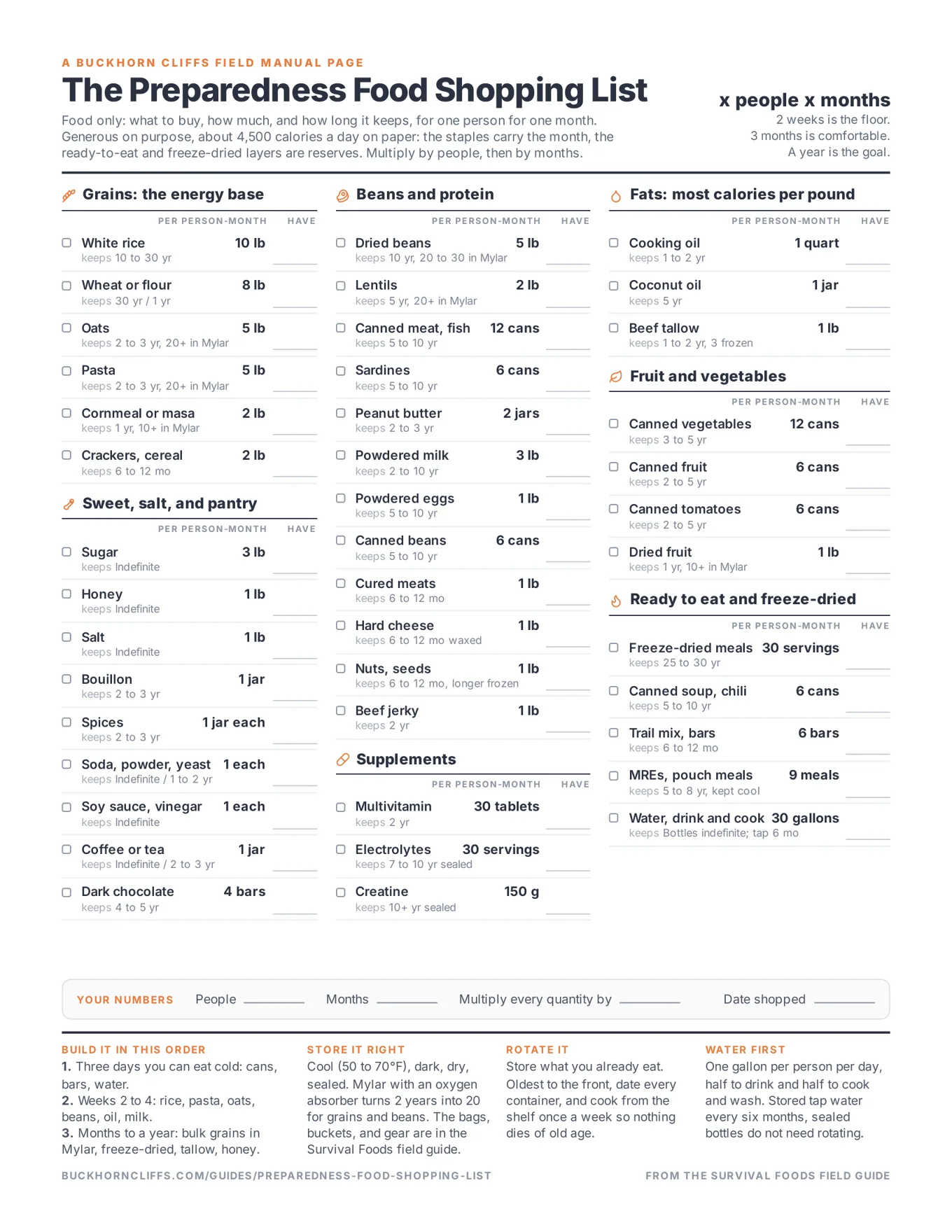
Get the one-page food shopping list
What to store, how much of it for one person for one month, and how long it keeps. One page with checkboxes, built from the Survival Foods field guide. Print it, multiply by your people and months, and take it to the store.
The PDF comes by email, with my newsletter now and then. Already on the list? You still get it. Read the full page.
The best bug-out bag: how to choose, and the three I carry
There is no best bug-out bag, only the best bag for the pile on your table and the way you carry. Buy it last. For most people that is a waterproof 30 liter roll-top; the other two below are for a pistol and a carbine. All three are packs I own and use.
GRAYL Transport EXP, 30 liters
The general pack · waterproofA waterproof roll-top pack with an air release valve so it compresses, a weatherproof front panel for the small things, and an inside that takes a hydration bladder, a laptop and the GeoPress. Thirty liters is enough for everything on this page without the rifle. When the medical kit, the radio and the phone are inside, rain is not a problem. The pack for most people.
Eberlestock Switchblade
The pistol pack · 29 liters, 500D CorduraA low-profile pack with magnetic side openings that put a concealed pistol in your hand without taking the pack off, loop-lined walls inside for a holster and pouches, dual magazine pouches, a 17 inch laptop sleeve and a MOLLE-10 system that cuts the weight of standard webbing by about 60 percent. 1,785 cubic inches, a ventilated back panel, hydration compatible. It looks like a work bag, which is the point.
Eberlestock Fade Adapt
The carbine pack · 28 to 40.7 litersA daypack with a hidden, expandable scabbard. Collapsed, it takes a 10.5 inch AR with a folding stock adapter, about 21 inches tall with an A2 muzzle; expanded, a rifle up to 27 inches. The scabbard is its own compartment with a quick disconnect retention strap, a structured bottom and side compression, so nothing rattles and the draw is fast. 21.75 by 12.25 by 7.5 inches, 4 pounds 2 ounces, 1,717 cubic inches collapsed and 2,545 expanded. My 9mm carbine rides in it with room for everything else here.
Eberlestock Recon bino harness and handwarmer
On the chest · optics and small toolsA chest rig with a magnetic forward-pull lid that puts binoculars in your hands in one motion and keeps them protected the rest of the time, a 3D mesh harness that breathes, MOLLE wings for a rangefinder or a radio pouch, and tethers so the glass never hits the ground. The handwarmer clips to the bottom of it: a muff with a pocket for chemical warmers and its own waist belt, so hands stay working in the cold. What rides on the chest does not need the pack off to reach.
How to load whichever bag you choose, heavy close to the spine and the trauma kit on top, is on how to pack your backpack. The Fogland 25 liter loadout is the same idea in a smaller waterproof bag.
What any pack needs
Whichever bag you choose
| Thirty liters, give or take | The pile fits; a bigger bag fills itself with things you will not carry |
| Waterproof fabric or a roll-top; a cover at least | The trauma kit, the radio and the phone are the things that must stay dry |
| A hip belt and a chest strap | Twenty-five pounds on shoulders alone is a sore mile; on hips it is an easy three |
| Lid and hip pockets | What you use on the move never needs the bag off: light, snacks, map, spray |
| A laptop sleeve or a flat back pocket | The documents, the drive, the map, and a laptop if it is part of the plan |
| Plain looks | Camouflage and webbing say prepper in a motel lobby. A work bag says nothing |
Packing it: where each thing goes
The load carries best when the heaviest things sit against your back and between the shoulder blades, the soft things make the floor, and the one thing you need in a hurry is on top. The zones, from the top down:
Flashlight, lighter, map and compass, a bar, the spray, gloves, the whistle. Nothing in a pocket should need the pack off.
Where a stranger can find the kit while you are the patient, in a red pouch or strapped outside. The respirator is the first thing on when the smoke arrives.
The heavy half, centered and high. A liter of water is 2.2 pounds; three days of food is about 4. Off center, the bag pulls you sideways every step.
Mid-weight things (cook kit, cord, tape, the everyday kit) under the heavy band and above the blanket so the load does not shift; the lightest (rain shell, wool, hygiene) highest and farthest from your back.
Needed once, at night, in no hurry. Soft, so the bag stands up on its own and nothing hard rides on your hips.
The fixed blade on the belt, the folding knife and the multitool in a pocket, the binoculars and the radio on the chest rig, the phone in the Faraday bag in a jacket pocket.
The full method, with the compression straps, the bladder and the stuff sacks that keep it this way after the third repack, is on how to pack your backpack. Hand the finished bag to someone else and time how long they take to find the tourniquet.
Weight, seasons, where the bags live, and when to leave
A typical bag, rounded, from the item weights; put yours on a bathroom scale. The point is that water and warmth are a third of it and the cuts come from food and shelter, never from bleeding, water or warmth.
The weight budget, by job (pounds)
| Bleeding, medical | 1.5 |
| Air | 0.6 |
| Water: purifier bottle, second bottle, powder | 1.4 |
| Fire and cooking | 1.2 |
| Cutting and repairs | 2.2 |
| Light | 0.5 |
| Seeing and finding | 2.0 |
| Contact and power | 1.6 |
| Warmth and shelter | 5.2 |
| Food, three days | 4.0 |
| Cash, papers, drive | 0.3 |
| Hygiene | 0.9 |
| The empty pack | 2.5 |
| Dry, everything above | 24 |
| Two liters of water carried | 4.4 |
| On your back, day one | 28 |
What changes with the season
Winter in: the heavier wool, a second pair of gloves, chemical hand warmers, the second Mylar, a candle in a tin, lip balm, and the water bottles start the day inside the jacket. Summer in: sunscreen, insect repellent, a brimmed hat, a bandana, a third liter of water, more electrolyte powder, a lighter blanket. The trauma kit, the fire kit, the purifier, the radio, the food and the papers never change; the swap is the clothes and the comfort layer, on the two clock-change days.
Where the bags live
One per person, this bag, where you leave the house. Not the basement, not the closet upstairs.
A get-home version: water, a light, walking shoes, a shell, a bar, with the car kit around it. It is for getting back to the door bag, not away from it.
A shell, shoes you can walk in, water, a light, cash. The smallest of the three, in a desk drawer.
An evacuation order for your zone. Gas you can smell on the street. Water rising toward the house. A fire you can see from the yard with the wind toward you. A structural problem after a quake or a storm. A night with no heat below freezing and no way to make it. Everything else, the blackout guide says, is a reason to stay, and bugging out early is the mistake the bag must not cause.
A Stop the Bleed class. A fire with the ferro rod in the rain. The tarp as an A-frame in five minutes with a taut-line hitch and a trucker's hitch. A GMRS check-in across the property. A mile of the evacuation route by map and compass. One night in the yard in the blanket. None takes a weekend; all of them together are the difference between a bag and a plan.
Bleeding and medical
The trauma kit rides in the top of the bag or on the outside. Take a Stop the Bleed class, about 90 minutes and usually free; a tourniquet you have never put on is a tourniquet that goes on wrong. Two pairs of nitrile gloves and a CPR pocket mask ride with the kit, because the patient is often not family. The medical preparedness guide covers the training and the deeper kit.
JaseAid Trauma Kit
Bleeding, airway, chestA professional Stop the Bleed kit: an ETQ wide tourniquet, an Israeli compression bandage, hemostatic gauze, a Slishman wrap, z-fold gauze, a Hyfin compact chest seal, a 28F nasal airway with lubricant, a thermal blanket, trauma shears, a 5 by 9 abdominal pad, an aluminum eye shield, a burn dressing, a light and a marker, with instructions in the lid. It also carries a Trauma Pill Pack, prescription medication for infection, inflammation, pain and nausea, dispensed through Jase Medical. This is the kit for a deep laceration, a gunshot wound or a chainsaw, the injuries where the first ten minutes decide the outcome.
JaseAid Mini Kit
Cuts, sprains, blisters, headachesThe everyday companion to the trauma kit: bandages, wound closure strips, antiseptics, topicals, sprain and fracture supplies and basic over-the-counter medication, each in its own labeled section. There is some overlap with the trauma kit on gauze and wipes; the difference is purpose. This one gets opened on a normal trip. The trauma kit gets opened once.
Leukotape P
Blisters, sprains, holding a dressingA rigid, aggressive strapping tape that stays on wet skin for days. Over a hot spot it stops a blister forming; around an ankle it splints a sprain well enough to walk out; over a dressing it holds through a day of work. Far stronger than athletic tape, and one roll covers a year of trips.
Electrolytes, salt, activated charcoal
Three pill bottlesThree emptied supplement bottles. One of Cardnl zero sugar electrolyte powder and one of Redmond Real Salt, because sweat takes salt as well as water and cramps and a headache are the warning. One of activated charcoal, which binds many swallowed drugs and toxins in the gut if taken within about an hour: call Poison Control (1-800-222-1222) first, never give it to someone drowsy, and know it does nothing for acids, alkalis, alcohol, petroleum or metals. For spoiled food, rehydration comes first.
Air
Avon MITR-M1 half mask
Smoke, dust, ash · code BUCKHORNA professional half-mask respirator with a soft silicone seal and a side-mounted MITR-PF filter, 99.97 percent particulate efficiency, that keeps your cheek weld clear on a rifle and your vision clear everywhere else. Wildfire smoke, ash, dust from a collapsed building, and on the ordinary day, sanding, brush burning and cleaning the coop. It is a particulate filter only: it does not stop gases, vapors or carbon monoxide. Store filters sealed and cool, rotate them yearly, and once a filter is opened it is in use until it is replaced. My MITR-M1 guide has the field examples.
Water and cooking
What is in the bag on day one: two liters, full, the purifier bottle and the Nalgene. That is the first half day; the purifier and the taps along the way are the rest of the gallon. Dry bottles by the door are the most common mistake in this job.
GeoPress Ti purifier and dining set
Water and the pot · one systemA 24 ounce titanium purifier bottle. One press, about 8 seconds, removes viruses, bacteria and protozoa and reduces particulates, chemicals, pesticides and heavy metals from nearly any fresh water. Pull the inner press and cartridge out and the outer cup goes on the stove or beside the coals to boil, which is a second way to make water safe and a cook pot in the same bottle. The bundle adds a titanium bowl, plate and spork that nest with it. Clean water covers what each method handles.
GRAYL titanium stove and 100 g isobutane
Heat · 28 gramsA 28 gram titanium canister stove with up to 9,200 BTU and a valve that simmers, folding pot supports that hold the GeoPress cup, and a stuff sack the size of a lighter. It screws onto a 100 gram isobutane and propane canister that works in the cold, boils about a dozen liters per can, and nests inside the cup with the stove. Hot water is coffee, oatmeal, a freeze dried pouch and a sterile rinse; this is the smallest reliable way to make it.
Fire
Lighter, ferro rod, stormproof matches, fire plugs
Three ways to light, one tinder that does not careEach one covers the failure of the others. A butane lighter is fast and can freeze or run dry. A ferro rod works wet and lasts thousands of strikes. Stormproof matches are simple when nothing else is. Black Beard fire plugs are the tinder: waterproof, windproof, odorless, each burning up to eight minutes, long enough to dry damp kindling, with a 30 year shelf life in a resealable bag. Matches live in a waterproof tube, the spare lighter in a sealed pouch, and everyone in the house has practiced with all three; fire making techniques is the how.
Tallow and beeswax tin
Made at home · leather, skin, fireTwo parts beeswax to one part beef tallow, melted low and poured into a small tin. It waterproofs leather, wood and canvas, preserves a tool handle, works as a hand salve and lip balm, and shaved into curls it is a fire starter. The recipe is on this site. Keep the tin in a zip bag.
Cutting and light
Toor Mullet S fixed blade
The knife · mid-back scout carryA midsize fixed blade that puts mass into a short footprint: 8.5 inches overall, a 4 inch blade of CPM M4 tool steel at 59 to 61 HRC, 3/16 inch thick with a short swerve grind that reinforces the tip, 7.5 ounces, G10 or ebony scales, a FlexTech Kydex sheath, and a tungsten carbide ball in the pommel that breaks a window. It batons, it carves, it processes game, and it has no hinge to fail. A fixed blade is the one tool in the bag that must not break.
Gerber Dual-Force multitool
The pliers and the driversLayered blunt-nose pliers with twice the grip of a standard design, two-position slip-joint jaws with big teeth, a 3.25 inch plain blade, a center-axis driver with onboard bits, a saw, wire cutters and a stripper, at 12 ounces on the belt. It fixes the things the knife cannot: a stuck fitting, a fence wire, a screw, a fuel line.
Olight Warrior Ultra 2500
The light · plus a headlamp2,500 lumens and 26,000 candela, which reaches about 320 meters, from a light that fits a pocket: a side switch with five modes for the ordinary job and a tail switch for the instant one, a proximity sensor that drops the output before it burns something in a pack, and magnetic charging. The headlamp in the small stuff section is the one for camp chores; this is the one for finding the trail, the tail light or the noise.
ASP Defender LE pepper spray
The step before anything elseA professional OC gel, 1.4 percent major capsaicinoids and HPLC tested so every can is the same strength. Gel stays where you aim it and does not blow back in a room or a wind; UV dye marks whoever it hits; the flip-top safety works in gloves and the bag-on-valve sprays at any angle. About fourteen half-second bursts per can, roughly 15 feet of reach. It is the answer to a loose dog, a drunk and most confrontations, and it is legal in far more places than anything else that solves those problems.
Seeing and finding
8x42 binoculars
The glass · in the chest rigEight power is the most magnification most people can hold steady, and 42 mm objectives gather enough light for dawn and dusk. Fully multi-coated, waterproof, nitrogen purged so they do not fog. They tell you whether the road ahead is open, whether that is a trailhead sign or a fence post, and what is moving on the hillside, all without walking there.
TideWe rangefinder
Distance · 700 yardsA 6x laser rangefinder to 700 yards, accurate within a yard, with horizontal and vertical distance for steep ground, a scan mode and a reading in under half a second. 0.35 pounds with a rechargeable battery good for about 20,000 readings. A hunting tool that also answers how far the river is and how far that is.
Kestrel 3500FW fire weather meter
Weather · made in the USAWind speed, temperature, humidity, pressure and altitude, plus dew point, wet bulb, heat index and wind chill, in an IP67 pocket instrument that meets MIL-STD-810F drop tests. The FW version ships with a waterproof card for working out fine dead fuel moisture and probability of ignition from those readings, which is what wildland crews use to decide whether the grass will carry fire today. Falling pressure means weather is coming; rising wind and dropping humidity mean a fire will run.
Contact and power
Rocky Talkie 5 watt GMRS with whip antenna
Contact · the family netWaterproof, shatterproof, 4 to 6 days on a charge in the cold, and the long whip antenna adds real range in open and hilly country. It talks directly to every other GMRS and FRS radio the family owns, and through a repeater across a county. GMRS needs an FCC license: no test, ten years, covers the whole family. How to communicate without cell or internet is the plan that goes with the radio.
Solis Go hotspot and power bank
Data anywhere there is any towerA hotspot that connects to the strongest available carrier in more than 130 countries with no SIM and no contract, with 1 GB of free data a month for life and day, gigabyte or month plans on top, and an 8,000 mAh battery with built-in USB-A, USB-C and Lightning cables. When your carrier's tower is dead and the one across the valley is not, this is how the phone gets a signal.
Anker 622 magnetic battery
Power · the phone, twiceA 5,000 mAh MagSafe power bank half an inch thick with a fold-out stand, a USB-C port for wired charging, and a magnet strong enough to stay on the phone in a pocket. One full phone charge, or the radio and the headlamp several times. The solar panel and the big power bank stay with the outage kit; this is the one that is always along.
JACKET Pro Faraday phone bag
Off the network on purposeTriple-layer nickel and copper Faraday fabric inside Cordura with a magnetic top closure, about 4.5 by 8 inches, sized for a phone. Inside it, the phone gets no cellular, Wi-Fi, Bluetooth, GPS or RFID: no tracking, no remote access, no accidental connection, and the battery stops draining hunting for a tower. It also holds the spare phone and the drives against the rare event that takes out electronics; the Faraday bag guide covers what the bag does and does not do.
Warmth and shelter
Horizon Hound down blanket
Warmth · 1.6 pounds, 32°FA 77 by 50 inch down quilt filled with RDS-certified duck down in a 20D water-resistant ripstop shell, rated comfortable around 32°F, that clips into a poncho and stuffs into its own sack the size of a loaf of bread. With the tarp over it and wool on, it is a night out; in the truck, it is a good night's sleep. A Mylar blanket goes over it, shiny side in, when it is colder than that.
8 by 10 foot tarp
Shelter · roof, floor, stretcherHeavy duty, reinforced grommets, waterproof coating. An A-frame or a lean-to for two with the paracord, a groundsheet, a gear cover in the truck bed, a rain catch, and with two poles an improvised stretcher. Eight by ten is the size that shelters two people and still folds into the bottom of the bag. The taut-line and the trucker's hitch on the knots page are what make it a shelter in five minutes.
Wool hat and socks
Warmth · the cheapest gear on the pageWool holds heat wet, wicks, and does not stink on day three. A beanie that covers the ears stops the heat loss from the head that makes a cold night miserable; medium or heavyweight merino socks keep feet warm, dry and unblistered, and a spare pair in a zip bag is the single best morale item in the bag. Why wool covers the rest of the case.
Leather work gloves
Hands · Thinsulate linedThick cowhide with a reinforced palm, a Thinsulate lining that warms without bulk, water resistant leather, a gunn cut that lets the fingers work and a knit wrist that keeps the snow out. Firewood, hot pots, wire, rope, a broken window: every job in an evacuation is a hand job, and cold cut hands stop working.
Repairs and small stuff
TITAN Survival paracord 550
Cord · with fishing line, wire and tinder insideRated at 620 pounds, above mil-spec, with three survival strands woven in: 25 pound monofilament fishing line, 30 gauge utility wire, and a paraffin-infused jute strand that lights wet. Tarp lines, a bear hang, a splint tie, a snare, a boot lace, a fire. A hundred feet weighs a few ounces. Synthetic rope is the bigger stuff for the truck.
MODL Infinity ToolKit
Straps · one system instead of a pileEighteen silicone loops with studs and links, in two lengths and in black, orange and glow green, that connect into straps, lashings, hangers and handles of any length. It replaces the bungees and Velcro that used to rattle around the bag: a saw lashed to the outside, a lantern hung, a bin lid held, a load tied to the rack.
ShamWow cloth
The towelA 20 by 23 inch cloth that holds ten times its weight in water, wrings out, does not mildew in a bag and washes forever. A bath towel, a dish towel, a way to dry a soaked jacket, and laid on wet grass at dawn it collects drinking water.
Toothbrush, toothpaste tablets, flossers
Hygiene · a toothache is an emergency on day fourA toothbrush, a small jar of toothpaste tablets (chew, brush, rinse, no tube to burst) and a handful of disposable flossers in a waterproof pouch. Three days without them is uncomfortable; three weeks without them is an infection with no dentist. Body wipes for the rest.
The small stuff
Each one earns its ounce- Ranger bands, cut from inner tube: bundling, strapping a light to a pole, and a fire starter that burns wet.
- Duct tape, 20 feet folded flat: gear, tarp, boot and blister repair.
- Headlamp: hands free for camp, the tent and the first aid kit, with spare batteries.
- Needles and thread: a torn strap or pant leg, and a sterile needle for a splinter.
- Fishing kit: line, hooks and sinkers in a tin; the paracord carries more line.
- Compass: with the county map, the navigation that never needs a battery.
- Carabiners, two or three rated ones: hanging, clipping, rigging.
- Tweezers: splinters, ticks, glass.
- Folding knife: the pocket blade for food and cord, so the fixed blade stays sharp.
- USB cords, car adapter, wall charger: every device in the bag charges from the truck and from any outlet.
- Garbage bags, contractor grade: rain cover, ground sheet, water carrier, waste.
- Folding hand saw: firewood and shelter poles faster and safer than the hatchet.
- Waterproof notebook and pencil: routes, contacts, what you have used.
- Body wipes: a shower with no water.
- Nalgene wide-mouth bottle: a second liter, a hot water bottle in the blanket, and it does not leak.
- Signal mirror and whistle: seen and heard farther than you can shout.
- Toilet paper, a plastic trowel, hand sanitizer, feminine hygiene: half a roll flattened in a zip bag. The job the hygiene list always skips.
- Sunscreen, insect repellent, a brimmed hat: the summer set, swapped in on the spring check.
Food and cash
Three days of food that needs no cooking
About 2,000 calories a day per personSardines in oil for protein and fat. Meat sticks, nitrate-free. Honey packets, which never spoil and dress a wound. Nut butter packets for dense calories in the cold. Dried fruit and nuts. Protein bars. Instant oatmeal for the mornings there is hot water; the oatmeal packets I make keep for years. A few tea bags weigh nothing and fix a bad evening. Electrolyte powder for the heat and for illness. Rotate it every spring, and keep a couple of freeze dried pouches at the bottom for the day it stretches past three; the stove and the purifier are what make that possible. The freeze dried foods page covers the pouches.
Three days, one person, about 2,000 calories a day
Morning: oatmeal packet, honey packet, tea. Midday: two nut butter packets, dried fruit. Evening: tin of sardines, a sleeve of crackers. Between: two meat sticks, a bar, a handful of nuts.
Morning: oatmeal packet, honey packet, tea. Midday: two meat sticks, nuts, dried fruit. Evening: tin of sardines, a sleeve of crackers. Between: two nut butter packets, a bar.
Morning: oatmeal packet, honey packet, tea. Midday: bar, nuts, nut butter packet, crackers. Evening: freeze-dried pouch, hot water. Between: two meat sticks, dried fruit.
$300 in small bills
Cash · when the card readers are down$20 in ones, $80 in fives and $200 in twenties, sealed in a bag in the bottom of the pack. When the power is out, the ATMs and the card readers are out with it, and the one gas station on a generator sells for cash and cannot make change for a hundred. Fuel, a room, a meal, a ride. It also buys things quietly, without a phone or a card leaving a record of where you were.
Papers, keys, and the reunification pouch
On paper and on a driveCopies of IDs and passports, and birth certificates for the children. Insurance cards and policy numbers with the claim phone numbers. Prescriptions and the medication list with doses, the pharmacy and the doctor. A page of phone numbers: family, neighbors, the vet, the bank. A spare house key and car key, a roll of quarters. A recent photo of every family member and pet, printed, with name, age, height and any medical note on the back, because shelters, police and neighbors ask for it and the phone is the thing that is dead. The meeting places written down: one near the house, one outside the neighborhood, one outside the county, with the out-of-area contact everyone calls. All of it on an encrypted drive too, with photos of every room of the house for the claim.
Who else is in the bag: children, infants, the elderly, and pets
One bag per person, and a plan for the ones who cannot carry theirs.
Their water, their snacks, a small blanket, a headlamp, a whistle on the strap, a card with the family phone numbers and the meeting place, and one comfort they chose: a book, a toy, a deck of cards. In a pack they picked, at a tenth of their body weight.
Three days of formula or the pumped supply, bottles and a way to clean them, diapers and wipes for three days, a change of clothes, the carrier or sling so your hands are free, and a copy of the immunization record. The infant's load goes in the adult's pack and comes out of the adult's food and shelter weight.
A week of every medication with the written list and doses, spare glasses, hearing aid batteries, the care plan on paper, any device charger, and the pharmacy and doctor phone numbers. If walking a mile is not possible, the bag is packed for reach at the truck and the plan is the vehicle.
Three days of food in a sealed bag, a collapsible bowl, a leash and a collar with a tag, a carrier for the cat, a copy of the vaccination record for the shelter that asks, a photo, and any medication. Many shelters do not take pets at all, and the ones that do want them in crates; find out which ones near you do before the day, and the crate rides in the truck.
Who carries what
| Person | Carries | Weight ceiling |
|---|---|---|
| Adult | Their bag, plus the infant's or the pet's load | A fifth of body weight |
| Child, about 8 and up | Their own water, snacks, blanket, light, whistle | A tenth of body weight |
| Younger child | A small pack with the comfort item and the card | Almost nothing |
| Anyone who cannot walk a mile | Nothing; their bag goes in the truck and the plan is the vehicle | None |
The mistake is one big family bag carried by one person with the children's hands empty: too heavy to carry, and the one time it is needed the children are passengers in their own evacuation.
One caliber, two guns
9mm PCC and a micro-compact 9mm
My picks · where legal, with trainingA pistol caliber carbine and a concealed pistol in the same cartridge simplifies everything: one ammunition to stock, one to train with, one to resupply. My carbine is the Daniel Defense PCC with a Holosun HS510C red dot and, where legal, a StingerWorx EVO Ti suppressor; it gives a longer sight radius, less recoil and easier hits than a handgun in a package that rides in the Fade Adapt scabbard. My pistol is the Springfield Hellcat 3, a micro-compact with high capacity and an optics-ready slide that carries comfortably every day. The magazines do not interchange: the DD PCC takes CZ Scorpion pattern magazines and the Hellcat its own. Training, secure storage and the law where you are come before any of it; home security and defense and the sling guide cover the rest.
The checklist
Bleeding, air, medical
- JaseAid Trauma Kit, on top
- JaseAid Mini Kit
- Leukotape P
- Electrolytes, salt, activated charcoal in pill bottles
- Nitrile gloves, CPR mask
- Avon MITR-M1 half mask and a sealed filter
Water, cooking, fire
- GeoPress Ti and dining set, full
- Titanium stove, 100 g isobutane
- Nalgene bottle, full
- Lighter, ferro rod, stormproof matches, fire plugs
- Tallow and beeswax tin
Cut, light, see, find
- Fixed blade, folding knife, multitool, folding saw
- Flashlight, headlamp, spare batteries
- Binoculars, rangefinder, Kestrel
- Compass, county map, waterproof notebook
- Signal mirror and whistle
Contact and power
- Rocky Talkie 5 watt GMRS, whip antenna
- Solis Go hotspot
- Anker 622, USB cords, car adapter, wall charger
- Faraday phone bag with the spare phone
Warmth, shelter, repairs
- Down blanket, Mylar blankets
- 8x10 tarp
- Wool hat, wool socks and a spare pair, leather gloves
- Paracord, MODL straps, duct tape, ranger bands, zip ties, carabiners
- Needles and thread, fishing kit, tweezers
- Garbage bags, ShamWow, body wipes, oral hygiene kit
- Toilet paper, trowel, hand sanitizer
- Sunscreen, repellent, brimmed hat (summer); warmers, candle, second Mylar (winter)
Food, cash, papers
- Three days of no-cook food, electrolytes
- $300 in small bills
- Copies of IDs, insurance and prescriptions on paper and on an encrypted drive
- Spare keys, quarters, the family photos, the meeting places
A child's bag
- Water bottle, full
- Snacks they chose
- Small blanket
- Headlamp
- Whistle, on the strap
- A card with the family phone numbers and the meeting place
- One small comfort
Pets
- Three days of food, a bowl
- Leash, collar with tag, carrier
- Vaccination record, photo, medication
Walk a mile with it before you call it done, then three. Hand it to someone else and time how long they take to find the tourniquet.
Twice a year, when the clocks change
Eat the food and replace it, dated. New batteries; charge the radio, the power bank and the spare phone. Check the dates on the medical kit, the medications and the respirator filter. Swap the water in the bottles. Put back what got borrowed for camping.
Charge everything again. Swap the wool and the rain shell for the heavier set. Walk the evacuation route once and note what changed. Update the phone number card and the drive. Reseal the cash. Put the bag back by the door.
The eight bags that fail
- The 45 pound bag. Built for a week in the woods, it stays in the basement on the day. Weigh the pile; a fifth of body weight is the ceiling.
- The tourniquet still in its wrapper. Never practiced, it goes on wrong in the worst minute. The class, then your own leg, one-handed, once a season.
- The trauma kit at the bottom. Packed first, buried under the blanket. On top or outside, every repack.
- One lighter, dead. Three winters in the bag and empty. Three ways to light and a tinder that lights wet.
- Radios with no channel agreed. Everyone has one, nobody is on the same one, and the batteries are flat. The channel card, the check-in times, the twice-a-year charge.
- No respirator. Skipped as overkill until the sky is orange. A half mask and a sealed filter, on top with the trauma kit.
- Food that needs the stove. Freeze-dried for three days in a motel parking lot. No-cook food, two pouches at the bottom for the day it stretches.
- Never walked with. Packed once, never carried, never repacked after the camping trip borrowed the stove. A mile the day it is built, then the two check days a year.
Questions this answers
Tap a question for the short answer.
How many days should a bug out bag cover?
Three. Most evacuations end in a motel, a relative's house or the truck inside 72 hours, and three days is the weight one person can carry. A stove and a purifier are what let it stretch past that if it has to; a bigger bag does not.
What is the best bug out bag?
The one that fits the gear you already laid out and the way you carry. For most people that is a waterproof 30 liter roll-top pack. If you carry a pistol, a pack with a quick-access side opening. If you carry a carbine, a pack with a scabbard. Those are the three I use and the page says why; none of them is right until the gear is on the table.
How do I make a bug out bag?
Gear on the table first, bag last. Lay out one item per job from the twelve jobs, weigh the pile, and cut until it is a weight you can carry for a day; a fifth of your body weight is the ceiling, less is better. Then pick a pack that fits it and the way you carry, pack heavy and close to your back and the trauma kit on top, put it by the door, and walk a mile with it. Rotate the food, batteries and medications every spring. The page walks through each step.
What is typically in a bug out bag?
Three days of supplies for one person, packed by the job each item does: a trauma kit for bleeding, a respirator for smoke, a way to purify water and a pot to boil it, three ways to light a fire, a fixed blade and a multitool, a headlamp, a map and compass, a GMRS radio and a power bank, a blanket and a tarp, cord and tape for repairs, about 2,000 calories a day of food that needs no cooking, cash in small bills, copies of documents, and medications. The twelve-job list on the page is the full version; the bare minimum is the list in the callout at the top.
What should I put in a bug-out bag?
Pack by the problem, not the product. Bleeding: a tourniquet, a pressure bandage, hemostatic gauze and a chest seal, plus a small kit for cuts and sprains. Air: a half-mask respirator for smoke and dust. Water: a purifier bottle. Fire: a lighter, a ferro rod, stormproof matches and fire plugs. Cutting: a fixed blade and a multitool. Light: a flashlight and a headlamp. Contact: a GMRS radio and a power bank. Warmth: a down blanket, a tarp, wool hat and socks, a Mylar blanket. Repairs: paracord, duct tape, zip ties, tape. Food for three days that needs no cooking, and $300 in small bills.
What is the best backpack for a bug-out bag?
One that fits your torso, carries 25 to 40 liters, and matches how you carry. For most people that is the GRAYL Transport EXP, a 30 liter waterproof roll-top that keeps the medical kit and the electronics dry in a downpour. If you carry a pistol, the Eberlestock Switchblade has magnetic side openings for a concealed holster and mag pouches. If a carbine goes with you, the Eberlestock Fade Adapt hides a rifle in a scabbard and still looks like a daypack. Buy the bag last, after the gear is on the table and you know how much of it there is.
What backpack can carry a carbine discreetly?
The Eberlestock Fade Adapt. An internal scabbard collapsed holds a 10.5 inch AR with a folding stock adapter, about 21 inches; expanded it takes a rifle up to 27 inches tall. A quick release retention strap, a structured bottom and side compression keep it quiet, and from the outside it is a 28 liter daypack. A 9mm pistol caliber carbine fits it with room for everything else on this page.
What trauma kit should I carry in a bug-out bag?
A real Stop the Bleed kit, not a box of bandages: the JaseAid Trauma Kit carries a wide tourniquet, an Israeli bandage, hemostatic gauze, a Slishman wrap, z-fold gauze, a chest seal, a nasal airway, shears, an abdominal pad, an eye shield and a burn dressing, plus a pill pack of prescription antibiotic, anti-inflammatory, pain and nausea medication. It rides on top of the bag where anyone can find it. The JaseAid Mini Kit beside it handles the cuts, blisters, sprains and headaches that actually happen most days.
What water purifier is best for a go bag?
The GeoPress Ti. One press purifies 24 ounces in about 8 seconds: viruses, bacteria and protozoa gone, chemicals and heavy metals reduced. Pull the inner press out and the titanium outer cup boils water on the stove or the coals, which is a second purification method and a cook pot in the same bottle. The bundle adds a titanium bowl, plate and spork that nest with it.
What radio should I pack for an evacuation?
A 5 watt GMRS handheld with a whip antenna. The Rocky Talkie is waterproof, runs 4 to 6 days on a charge, and the long antenna adds real range in open or hilly country; it talks to every other GMRS and FRS radio in the family and through a repeater across the county. The license is ten minutes and no test. How to communicate without cell or internet covers the plan that goes with it.
What is the bare minimum for a bug out bag?
If you are starting from nothing: a waterproof bag, Mylar blankets, a multitool, a ferro rod, a fixed blade, a headlamp, a hatchet, paracord, duct tape, zip ties, carabiners, a towel, a compass, a GMRS radio, a solar charger, a water filter and bottle, a small propane or isobutane stove and a pot, a spork, and the trauma basics: tourniquet, wound closure, chest seal, non-stick gauze, iodine, a splint, ibuprofen, an antihistamine and Leukotape. That list is the Bug-Out and Go-Bags page of the Stockpile Essentials field guide, and it is the order to buy in.
How heavy should a bug-out bag be?
A fifth of your body weight is the ceiling with water and food in it, and lighter is better; about 24 pounds dry and 28 with two liters of water for the bag on this page. Everything on this page fits that if you carry one of each thing, not two. Put the bag on and walk three miles with it before you decide it is done. A bag you cannot carry is a bag you will leave in the truck.
What food goes in a bug-out bag?
Three days of calorie-dense food that needs no cooking and keeps for a year in a hot truck: sardines, meat sticks, nut butter packets, honey packets, dried fruit, protein bars, instant oatmeal for when there is hot water, and electrolyte powder. About 2,000 calories a day per person. Rotate it every spring; the stove and the purifier make it possible to stretch to a week with freeze dried pouches.
How much should a bug out bag weigh?
A fifth of your body weight is the ceiling for a day on foot, less is better, and a child's bag is a tenth of theirs. A typical bag built this way is about 24 pounds dry and 28 with two liters of water: warmth and shelter about 5, food 4, cutting and repairs 2, the glass 2, and the empty pack 2.5. If it is over, the cuts come from food and shelter, never from bleeding, water or warmth.
What should a child carry in a bug out bag?
Their own water, their snacks, a small blanket, a headlamp, a whistle on the strap, a card with the family phone numbers and the meeting place, and one comfort they chose, in a pack they picked, at a tenth of their body weight. An infant's supplies go in the adult's bag and come out of the adult's food and shelter weight.
What goes in a bug out bag for a dog?
Three days of food in a sealed bag, a collapsible bowl, a leash and a collar with a tag, a carrier for a cat, a copy of the vaccination record for the shelter that asks, a photo, and any medication. Many shelters do not take pets at all, and the ones that do want them in crates, so find out which ones near you do and keep the crate in the truck.
How do I pack a bug out bag?
Heavy against your back and centered: water, food, the stove. Soft things at the bottom: the blanket, the tarp, spare socks. Mid-weight things between, light things highest and farthest from your back. The trauma kit on top or strapped outside where a stranger can reach it, and the things you use walking in the lid and hip pockets. The knife on the belt, the binoculars and the radio on the chest.
What I use for this
Gear from my recommended list
Keep going
Related to this
Membership · $49.95 per year
There is a lot more behind the lock
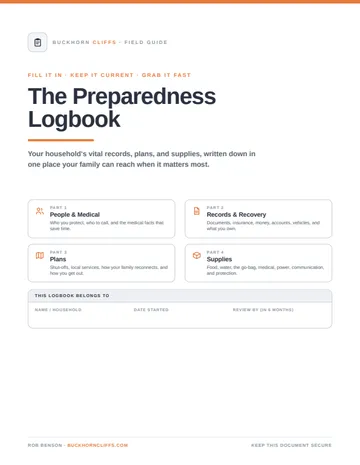
Every recipe and resource from the Prepper's Chemical Survival Guide, all eleven field guides to read here and download, the full audit and logbook, all twelve reference charts, and no ads.
My Manual · included
Build your own field manual
The most useful thing a membership gives you. Save any page on this site, recipes, charts, and whole field guides included. Arrange them in the order you want, name it, and print one manual with a cover and contents, or keep it as a PDF that opens with no signal.
- It works when this site does not
- Only your pages
- Anyone in the house can use it
- One current copy, not a pile of printouts
- The house binder
- A copy for the bug-out bag or truck
- A copy for family
- An offline PDF
Stay Ready
New entries, updates, and useful instruction.
Stay one step ahead on your preparedness journey.