Quick facts
- Freezer without power48 hours full, 24 hours half full, door shut; refreeze anything still at 40°F or with ice crystals
- Canned meat5 to 10 years stored cool; the label says 2 to 5
- Home-canned meatPressure only: 75 minutes pints, 90 quarts; broth 20 and 25
- Rendered fatTallow and lard 1 to 2 years airtight, 2 to 3 frozen; about 4,100 calories a pound
- JerkyHeat the meat to 160°F first; homemade keeps 1 to 2 months, 6 frozen; sealed store jerky 2 years
- Freeze-dried meatLean and cooked, 10 to 15 years; fat is what shortens it
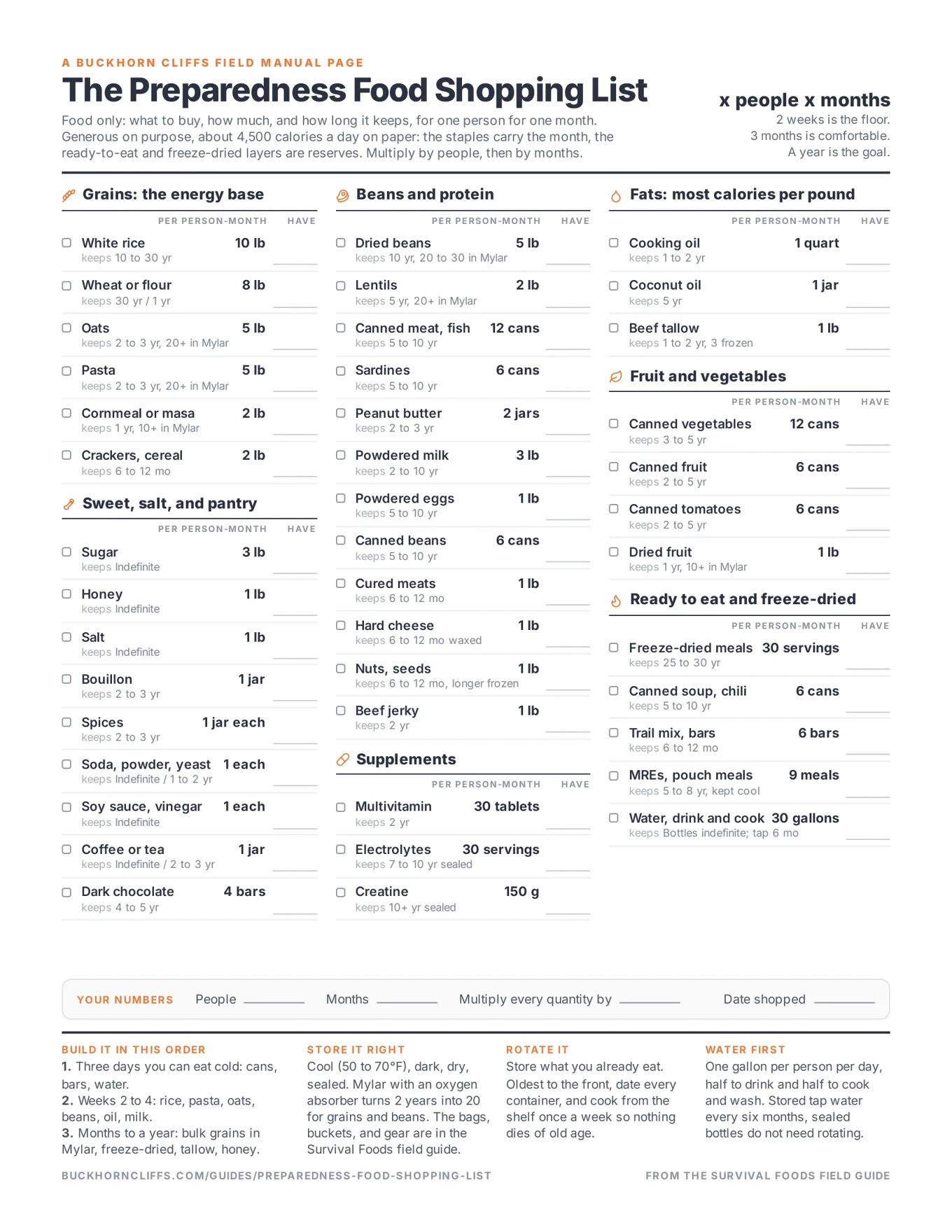
The food shopping list: what to buy, how much, shelf life
Most of what is written about food storage assumes rice, beans and wheat. If your household eats meat, eggs and fat and not much else, that advice stores the wrong things. The problem is not protein; cans and jars handle protein for years. The problem is fat, and the second problem is that the freezer most meat households lean on is a two-day plan the moment the power goes. This page is the meat version of the Survival Foods field guide: what keeps, for how long, and how to build a month of it that does not depend on a compressor.
What a meat household actually needs
Four things: protein, fat, salt and water. Protein is the easy one. A can of beef, chicken or salmon is cooked, sealed and good for years, and it needs no fuel to eat. Fat is the hard one, because fat is what carries the calories when there is no bread or rice on the plate, and fat is also what goes rancid first in everything you store. Salt is the cheapest line on the list and the one a meat table runs through fastest, since nothing you eat comes salted the way a bag of chips does. Water is the same gallon a day as everyone else, and a high protein table should plan on drinking the whole of it.
Run the calories before you buy. A 2,000 calorie day with no carbohydrate means most of it comes from fat, and a can of meat is a few hundred calories, not a day's worth; read the label on whatever you stock. Rendered tallow is about 250 calories an ounce, so 4 ounces a day is 1,000 calories from a jar that keeps for years. That one number is the whole plan: cans for the protein, a shelf of rendered fat for the calories.
The freezer is a 48 hour plan, not a storage plan
A full chest freezer with the door shut holds safe temperature for about 48 hours without power; a half full one holds about 24, and a refrigerator about 4 hours. Those are the USDA numbers and they are generous only if nobody opens the lid. Anything still at 40°F or below, or still holding ice crystals, can be refrozen; anything warmer than that for more than two hours is gone. Keep the freezer full (jugs of water fill the gaps and hold the cold), keep a thermometer inside it, and keep the lid shut until you have decided what to do.
The decision is: run it or empty it. A chest freezer draws little once cold, and a generator or a power station run a few hours a day keeps it frozen for weeks. Without that, 48 hours is your window to pressure can, dry or cook what is inside, which is why a meat household needs a pressure canner and a dehydrator more than it needs a second freezer. The quality clock runs even with the power on: steaks and roasts are best within 4 to 12 months, ground beef 3 to 4, whole poultry a year, bacon a month, fatty fish 2 to 3 months and lean fish 4 to 8. Frozen meat at 0°F stays safe past those; it just gets worse. Rotate the freezer into cans and jars on a schedule instead of discovering a freezer-burned brisket from three years ago.
Free download
Get the one-page food shopping list
What to store, how much of it for one person for one month, and how long it keeps. One page with checkboxes, built from the Survival Foods field guide. Print it, multiply by your people and months, and take it to the store.
The PDF comes by email, with my newsletter now and then. Already on the list? You still get it. Read the full page.
Canned meat: the base layer
Commercially canned meat and fish is the backbone: cooked, sealed, no water or fuel needed to eat it, and it keeps 5 to 10 years stored cool whatever the label says. Stock the ones you will eat cold from the can, because some days that is how they get eaten: beef, chicken, pork, corned beef, ham, salmon, tuna, sardines and mackerel. The fish bring fat with them; the canned chicken and beef mostly do not, so they lean on the tallow shelf.
Canning your own is how a freezer gets emptied in 48 hours. Meat is a low acid food, so it's pressure canning only, no exceptions: strips, cubes, chunks and ground meat all process 75 minutes in pints and 90 in quarts; meat stock and bone broth 20 minutes in pints and 25 in quarts. Pressure depends on altitude. A weighted gauge canner runs at 10 pounds up to 1,000 feet and 15 pounds above that; a dial gauge runs 11 pounds up to 2,000 feet, 12 to 4,000, 13 to 6,000 and 14 to 8,000. At my elevation that means 15 pounds on a weighted gauge and 13 or 14 on a dial, and getting that wrong is the one mistake in home canning that can kill you. Those are the National Center for Home Food Preservation figures; follow them, not a recipe blog.
Rendered fat: the calories
Tallow from beef and lard from pork are the storable fats. Rendered clean, strained and sealed airtight in a cool, dark cupboard they keep 1 to 2 years, and 2 to 3 years frozen, at about 4,100 calories a pound. The tallow page has the rendering method; the short version is low heat, strain through cloth until it sets white and smells of nothing, because leftover meat bits are what turn it. Pint jars, filled hot, keep better than one big tub that gets opened every day.
Butter does not keep on a shelf. Ghee, which is butter with the milk solids cooked out, keeps about a year, and canned butter keeps years sealed. Between tallow, lard and ghee you can hold a year of fat calories in a cupboard the size of a nightstand, which is the part of a meat pantry that most people never build.
Dried meat: jerky, pemmican and salt cure
Jerky is the dried meat everyone knows, and the USDA rule most people skip is the one that matters: heat the meat to 160°F (poultry to 165°F) before it goes in the dehydrator, because a dehydrator at 130 to 140°F may never get the meat itself hot enough to kill what is on it, and once dried, bacteria get harder to kill, not easier. Homemade jerky keeps 1 to 2 months in a jar and about 6 months frozen; sealed store jerky keeps about 2 years. It's a rotation food, not a decade food, and it is lean, so it does nothing for the calorie problem on its own.
Pemmican is how that problem was solved before refrigeration: dried lean meat pounded to powder and bound with rendered fat, traditionally about equal weights of each. It's dense, needs no cooking, and kept cool and sealed it was carried for years. Its shelf life is the shelf life of the fat in it, so make it with tallow rendered clean and store it the same way, cool and dark, and plan to eat through it in a year or two rather than treating it as a decade food. Salt curing is the third route and the one that needs the most care; the dry cure method has the ratios and temperatures, and the salt page explains why cures are weighed, never eyeballed.
Freeze-dried meat: the long shelf
Freeze-dried food in a sealed #10 can is the only meat that keeps for decades, and fat is again the limit. Low fat foods keep 25 years or more; meat, dairy and anything fatty is more like 10 to 15 years, because the fat still slowly goes rancid even dry. If you run a home freeze dryer, cook the meat, drain and pat the fat off, and freeze dry it lean; add the fat back at the meal from the tallow shelf. Pure fats, butter and fatty cuts do not freeze dry well. Bagged in Mylar with an oxygen absorber and kept cool, lean freeze-dried meat is the layer that sits behind the cans and never needs rotating.
Eggs, and the two things you will run out of first
Eggs keep 3 to 5 weeks refrigerated, and unwashed eggs with the bloom intact keep for weeks without a fridge. For months, water glassing in a lime solution (1 ounce of pickling lime per quart of water) is the old method and it still works; for years, powdered eggs keep 5 to 10 years sealed. The eggs page covers all three.
The two things a meat household runs out of first are salt and water. Salt keeps forever if it stays dry, costs almost nothing, and a meat-only table uses far more of it than the average pantry plans for; buy it by the 25 pound bag and keep a separate, labeled stock of curing salt that never reaches the table. Water is the same gallon a day as any household, with no reason to shave it. Build those two first, then the cans, then the fat, then the long shelf.
A month for one person, by the shelf
Cans: two a day, so about 60 cans, a mix of beef, chicken, fish and the fattier ones like salmon and sardines. Fat: 4 ounces a day, so 8 pounds of rendered tallow or lard, which is 8 pint jars. Eggs: a dozen water-glassed a week if you keep hens, or a can of powdered eggs. Salt: a few pounds, with the curing salt stored apart. Water: 30 gallons. Behind it, a pressure canner with spare gaskets and a dehydrator, so that whatever is in the freezer when the power goes becomes jars and jerky instead of a loss. Read the calorie line on every can before you settle on the count; the cans are the protein, and the jars of fat are the reason the month adds up.
Sources: USDA Food Safety and Inspection Service (power outage and cold storage times, jerky temperatures), the National Center for Home Food Preservation (pressure canning times and pressures by altitude), and the supply pages linked above for shelf lives.
Questions this answers
Tap a question for the short answer.
How do I store meat long term without a freezer?
Four layers: commercially canned meat and fish (5 to 10 years stored cool), home pressure-canned meat and broth, rendered fat in sealed jars (tallow and lard keep 1 to 2 years, 2 to 3 frozen), and lean freeze-dried meat in sealed cans for the decade shelf. Jerky and pemmican are the rotation foods in between.
How long does a freezer keep meat when the power is out?
About 48 hours if it's full and the door stays shut, about 24 hours half full; a refrigerator holds about 4 hours. Anything still at 40°F or below or still holding ice crystals can be refrozen. Those 48 hours are the window to pressure can or dry what is inside.
How long does canned meat last?
Stored cool, 5 to 10 years for beef, chicken, pork, ham, salmon, tuna and sardines, though the label says 2 to 5. Dents on a seam, swelling, rust or a spurt when opened mean the can is discarded.
How do I pressure can meat?
Pressure canning only; meat is low acid. Strips, cubes, chunks and ground meat process 75 minutes in pints and 90 in quarts; stock and broth 20 and 25. Weighted gauge: 10 pounds up to 1,000 feet, 15 above. Dial gauge: 11 pounds to 2,000 feet, 12 to 4,000, 13 to 6,000, 14 to 8,000. Those are the National Center for Home Food Preservation figures.
What is pemmican and how long does it keep?
Dried lean meat pounded to powder and bound with rendered fat, about equal weights of each. It needs no cooking and keeps as long as the fat in it does: made with clean-rendered tallow and kept cool, dark and sealed, plan on a year or two, and rotate it.
Does freeze-dried meat go bad?
Eventually, from the fat in it. Low fat freeze-dried food keeps 25 years or more sealed; meat and dairy are more like 10 to 15 years. Freeze dry meat cooked and drained lean, seal it with an oxygen absorber, and add fat back at the meal.
How much fat do I need to store on a carnivore diet?
Enough to carry the calories, since the cans will not. Tallow and lard run about 4,100 calories a pound, 250 an ounce, so 4 ounces a day is 1,000 calories: about 8 pounds, or 8 pint jars, per person per month.
Can I stock a carnivore diet for an emergency?
Yes, and more easily than most people think, as long as fat is stored on purpose. Cans for protein, jars of rendered fat for calories, salt and water built first, and a pressure canner and dehydrator so the freezer can be emptied in the 48 hours it holds without power.
Keep going
Related to this
Membership · $49.95 per year
There is a lot more behind the lock
Every recipe and resource from the Prepper's Chemical Survival Guide, all ten field guides to read here and download, the full audit and logbook, all twelve reference charts, and no ads.
My Manual · included
Build your own field manual
The most useful thing a membership gives you. Save any page on this site, recipes, charts, and whole field guides included. Arrange them in the order you want, name it, and print one manual with a cover and contents, or keep it as a PDF that opens with no signal.
- It works when this site does not
- Only your pages
- Anyone in the house can use it
- One current copy, not a pile of printouts
- The house binder
- A copy for the bug-out bag or truck
- A copy for family
- An offline PDF







Stay Ready
New entries, updates, and useful instruction.
Stay one step ahead on your preparedness journey.