Quick facts
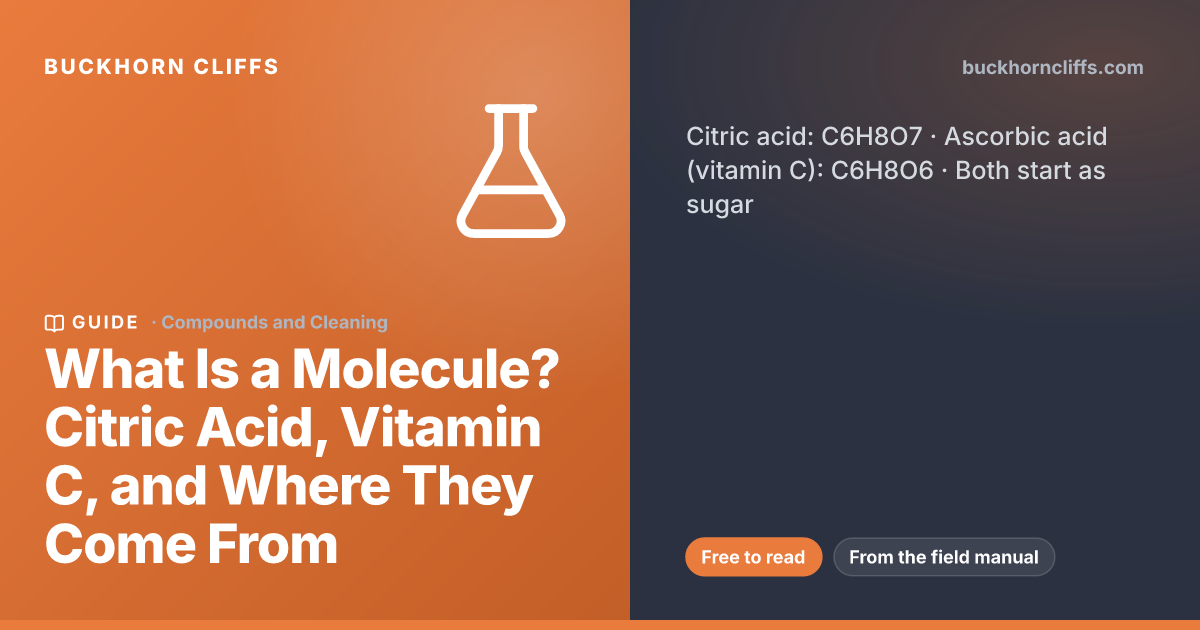
- Citric acidC6H8O7. About 90 percent is fermented from sugar or molasses by the mold Aspergillus niger
- Ascorbic acid (vitamin C)C6H8O6. Starts as glucose, usually from corn; most comes from a two-step fermentation
- In the jarCrystals of one molecule. No mold, no molasses, no lemon, no corn
- Natural or syntheticThe same molecule, so it does the same job
- Not vitamin CSodium erythorbate and erythorbic acid: same atoms, different shape
- Grade to buy
- Food grade
- USP
- or FCC
- KeepsCitric acid indefinitely, dry and airtight. Ascorbic acid 5 to 10 years sealed dry with a desiccant
Most citric acid is made by a mold, and most vitamin C starts as corn sugar. People hear that and assume the jar on the shelf is part mold or part corn. It isn't, and the reason comes down to one word: molecule. Once you understand what a molecule is, you can read a label, judge a powder, and know what you're actually storing.
What a molecule isHow citric acid is madeHow vitamin C is madeWhat's left in the jarSame atoms, different moleculeWhere purity mattersPowder against fruitEvery page for both
What a Molecule Is
A molecule is the smallest piece of a substance that's still that substance. It's a fixed set of atoms locked together in a fixed shape. Water is two hydrogen atoms bonded to one oxygen. Split it, and you no longer have water.
What matters is that a molecule is defined by its atoms and its shape, nothing else. It carries no record of where it came from. A water molecule from a glacier and one from a car's tailpipe are identical. The same goes for citric acid squeezed from a lemon and citric acid brewed in a steel tank.
Oxygen is drawn in orange. Each line is a bond, a double line is a double bond, and a corner with no letter is a carbon.
How Citric Acid Is Made
Citric acid was first made commercially in 1860 from lemons grown in Italy. That worked until World War I cut off Italian citrus exports. In 1917, James Currie found that a common mold, Aspergillus niger, could make citric acid from sugar, and that's still how it's done. About 90 percent of the world's citric acid comes from A. niger, fermented in large tanks fed sugar or molasses.
The steps, from sugar to crystals
- Feed the moldSugar or molasses goes into a tank of water with A. niger.
- FermentThe mold turns the sugar into citric acid in the liquid.
- Remove the moldThe mold is filtered out.
- Pull out the citric acidLime is added, and the citric acid drops out as solid calcium citrate, which is filtered and washed several times.
- Release itSulfuric acid turns the calcium into calcium sulfate (gypsum), which is filtered off, leaving citric acid in the liquid.
- CrystallizeThe liquid is concentrated and the citric acid crystallizes out.
China made 59 percent of the world's supply in 2015.
How Ascorbic Acid (Vitamin C) Is Made
Vitamin C starts as glucose, usually from corn. The original method, the Reichstein process from the 1930s, turns glucose into sorbitol with a nickel catalyst under high heat and pressure, ferments the sorbitol into sorbose with bacteria, then finishes the molecule with more chemical steps.
Most vitamin C today comes from a newer route. In the 1980s, a Chinese research institute developed a two-step fermentation process that Chinese manufacturers now use because it's cheap and gives high quality. That made China the world's vitamin C supplier, with about 85 percent of the global market.
The steps, from sugar to crystals
- Start with glucose.
- Convert it to sorbitol.
- Ferment it in two stages with bacteria into a vitamin C building block.
- Rearrange that building block chemically into L-ascorbic acid.
- Purify and crystallize.
What's Left in the Jar
What comes out of either process is crystals of one molecule, purified. Citric acid holds no mold, no molasses, and no lemon. Ascorbic acid holds no corn. The source is gone, and what's left is a molecule that's identical whether it came from a fruit, a tank, or a lab. Even patent filings on vitamin C production state it plainly: natural and synthetic vitamin C are chemically and biologically identical.
Citric acid
- Formula
- C6H8O7
- Starts as
- Sugar or molasses
- Made by
- Fermentation with the mold Aspergillus niger
- In the jar
- No mold, no molasses, and no lemon
- Keeps
- Indefinitely, stored dry and airtight
Ascorbic acid (vitamin C)
- Formula
- C6H8O6
- Starts as
- Glucose, usually from corn
- Made by
- Two-step fermentation with bacteria, then a chemical step
- In the jar
- No corn
- Keeps
- 5 to 10 years sealed dry with a desiccant
Your own body proves the point. Every cell you have makes citric acid as part of turning food into energy, which is why that cycle is called the citric acid cycle. The citric acid in your cells and the citric acid in the bag are the same molecule.
"Natural" on a label
"Natural" on a label tells you where something was sourced, not what it is. If the molecule is the same, it does the same job.
Same Atoms, Different Molecule
Shape matters as much as the atoms. Erythorbic acid has the same formula as vitamin C, C6H8O6, with one part of the molecule flipped. Think of your hands: same fingers, same thumb, but your left hand won't fit a right-hand glove. Chemists call that kind of match a stereoisomer.
That one flip changes everything. Erythorbic acid and its salt, sodium erythorbate, have no vitamin C value. They're used mostly in cured meats like bacon and hot dogs to hold the color and slow spoilage. So "sodium erythorbate" on a package isn't vitamin C, even though the atoms match. When you buy vitamin C for storage, the label should read ascorbic acid or L-ascorbic acid.
Where Purity Actually Matters
The molecule is never the problem. What can matter is what else rides along in a cheap or poorly made batch, which is why the grade on the bag matters.
You'll also see claims online that manufactured citric acid causes reactions. They trace back to a 2018 paper with four case reports of people who had repeated inflammatory reactions, including breathing trouble, joint pain, gut problems, and muscle pain, after eating foods and drinks with added citric acid. The authors' theory is leftover mold residue from manufacturing, not the citric acid molecule itself. Four cases is a lead, not proof, and allergists point out that the body doesn't make a specific antibody to a small chemical like citric acid. If you react to products with added citric acid but not to lemons, that's worth paying attention to, and lemon juice is your fallback.
Read the label
Look for
- The nameCitric acid, or ascorbic acid / L-ascorbic acid
- The gradeFood grade, USP, or FCC
- The sellerOne who lists the grade and the country of origin
Watch for
- Technical or industrial gradeMade for cleaning, not eating
- Sodium erythorbate or erythorbic acidSold as vitamin C
- Ascorbic acid that's turned yellowIt's lost strength
Why the Powder Beats the Fruit for Storage
Everything on This Site for Citric Acid and Ascorbic Acid
The compounds
- Citric Acidshelf life, uses, and what never to mix
- Ascorbic Acidshelf life, uses, and what never to mix
Reference and planning
Citric acid recipes
Sources
- Citric acid history, the lime and sulfuric acid recovery, and China's 59 percent share in 2015Moore, 21st Century Guidebook to Fungi, 17.14
- A. niger makes about 90 percent of the world's citric acidPLOS ONE, 2025
- Fermentation from sugar solutions or molassesUS Patent 4,855,494
- The Reichstein process stepsWikipedia: Reichstein process
- Two-step fermentation from the 1980s, and China's 85 percent of the global marketChinese Academy of Sciences
- Natural and synthetic vitamin C are chemically and biologically identicalUS Patent 6,037,480
- Erythorbic acid is a stereoisomer of ascorbic acidJECFA monograph
- Sodium erythorbate has no nutritional value and is used in processed meatsCSPI Chemical Cuisine
- The 2018 case reports on manufactured citric acidSweis and Cressey, Toxicology Reports 5:808-812
- No specific antibody to a small chemical like citric acidAAAAI Ask the Expert
- Shelf life of both compoundsPrepper's Chemical Survival Guide
Questions this answers
Tap a question for the short answer.
What is a molecule
The smallest piece of a substance that's still that substance: a fixed set of atoms bonded in a fixed shape. It carries no record of where it came from.
How is citric acid made
Mostly by fermenting sugar or molasses with the mold Aspergillus niger in tanks. The mold is removed, and the citric acid is pulled out with lime, released with sulfuric acid, then purified and crystallized.
How is vitamin C made
From glucose, usually corn sugar, by fermentation and chemical steps. Most comes from a two-step fermentation process used in China.
Does citric acid contain mold
No. The mold is removed and the citric acid is purified into crystals of one molecule. The citric acid molecule is identical whether it came from a lemon or a tank.
Is synthetic vitamin C the same as natural vitamin C
Yes. L-ascorbic acid is the same molecule whether it came from an orange or a factory.
Is sodium erythorbate vitamin C
No. Erythorbic acid has the same atoms as vitamin C in a different shape and has no vitamin C value. It's used mostly in cured meats.
Keep going
Related to this
Membership · $49.95 per year
Everything on this site, open, and your own manual that works with no internet
When the grid goes down, this site goes with it. Membership opens every member page and every recipe from the book, hands over all fourteen field guides as PDFs, and gives you your own manual built from the pages your household uses: searchable on your phone with no internet, and printable as one binder.
- 158member pagesopen in full, every amount and every step
- 138compound recipesfrom the hardcover book, exact amounts. Pick any and add them to your manual
- 14field guides313 pages of PDFs, $140 bought one at a time
- 9military field guidesUS Army manuals cut to 66 pages and laid out to use
- Offlineyour own manualbuilt from any page here, searchable on your phone with no internet
- Build your own manual on this site. pick any page, recipe, chart or whole field guide and put them in your order
- Download it and use it with no internet. it opens like an app on your phone or computer, searchable, with no power grid and no signal
- Print it or save it as one PDF. your cover, a contents page and every page you picked, laid out for paper
- All 138 recipes from my hardcover book. exact amounts for pool shock water purification, Lugol's iodine antiseptic, water glassing eggs, laundry powder and the rest
- All 14 field guides, 313 pages. Stockpile Essentials, Survival Foods, Bug-Out Bag, Home Canning, Solar Power and more, to read here or download
- 9 military field guides. Survival, First Aid, Mountaineering and the other US Army manuals, each cut to its most useful pages
- The Old Library, to print and keep. print any of 4,941 articles from the 1911 Britannica and two old formula books, or save them to My Manual
- 158 how-to pages in full. medical, hygiene, tools and repair, garden and livestock, food, water and more
- The audit, the logbook and the checklists. all 200 audit checkpoints, saved to your account on every device
- One payment, $49.95 per year. Cancel any time and keep access to the end of the year you paid for.
- Sign in by email. No password, and the sign-in renews itself on every visit.
- Most of the site stays free. Membership is for the depth, the PDFs and your own offline manual.


Stay Ready
New entries, updates, and useful instruction.
Stay one step ahead on your preparedness journey.