Quick facts
- Rule of threes3 minutes without air, 3 hours without shelter in bad weather, 3 days without water, 3 weeks without food
- First hourSTOP: sit, think, observe, plan. Stay where you are unless staying is dangerous
- Order of work
- Shelter and warmth
- fire
- signal
- water
- then food
- SignalThree of anything means distress: three whistle blasts, three fires, three flashes. A mirror flash carries 20 miles
- WaterClear, moving water is easier to treat, not safe. Boil one minute or filter and disinfect
- Before you goTell someone where and when. Carry the ten essentials. A satellite messenger or PLB where there is no signal
The people who die in the backcountry are rarely the ones in the survival shows. They are day hikers who took a wrong turn, hunters who followed an elk over one more ridge, a family whose car slid off a forest road, and most of them die of cold and wet within a day or two, a few miles from a trail, having walked past the spot where they would have been found. Surviving out there is mostly not doing that. It is stopping, staying warm, and being easy to find, and then doing a short list of work in the right order.
The first hour: STOP
Searchers start from your last known point and your planned route and work outward. A person who stays near that line, sheltered and signaling, is found, usually inside 72 hours. A person walking cross-country is a moving target who is also getting colder, tireder and hurt. The trip plan you left with someone is the search plan; that is why you leave one every time.
The order of work
Shelter that works
The roof is the easy part. What keeps you alive is insulation under and around you and a wall against the wind, in a space small enough for your body to heat.
Never sleep on bare ground. Even a pile of dry leaves or a pack under your hips halves the heat you lose.
Fire, including in the wet
Getting found
- Whistle: three blasts, pause, repeat. It carries a mile and never gets hoarse. It lives on a cord around your neck, not in the pack.
- Mirror: visible twenty miles in sun. Aim through the sighting hole, or hold a V of two fingers at arm's length toward the aircraft and sweep the flash across them. Sweep the horizon a few times an hour even with nothing in sight.
- Fire and smoke: three fires in a triangle if you can feed them; otherwise one big fire with a pile of green boughs or wet punk wood beside it to throw on when you hear an engine. White smoke by day, flame by night.
- Ground signal: an X or SOS at least twenty feet across, in an opening, from rocks, logs, trampled snow or dug earth, with contrast against the ground.
- Color and movement: the orange side of the blanket out, bright clothing on a rock, and wave a jacket at any aircraft.
- Phone: off or in airplane mode to save the battery, tried from high ground, and a text before a call. Where there is no signal, a satellite messenger or a PLB does all of the above with one button, which is why it is the one piece of gear I will not go without.
Water
Two to four quarts a day working, more in heat. Follow drainages down, watch for green strips and animal trails converging, listen at dawn. Prefer clear, moving water from as high in the drainage as you can get, and treat every drop: a one-minute rolling boil, or a filter to 1 micron plus chlorine or iodine drops. Clear mountain streams carry Giardia and clear water is not clean water. Avoid water below beaver ponds, pastures, camps and mines, and never a pond with green scum; boiling releases more algae toxin, not less. In dry country dig a seep at the outside bend of a sandy wash, wring dew from a cloth at first light, and melt snow rather than eating it, which costs more heat than it gives. The field water page is the full method.
The things that actually kill people
Before you go: the ten essentials
- Navigation: map and compass you know how to use, plus a phone or GPS with the maps downloaded
- Headlamp with spare batteries
- Sun protection: hat, glasses, sunscreen
- First aid kit, with blister care and a way to close a cut
- Knife, and a small saw or hatchet on longer trips
- Fire: lighter, ferro rod, waterproof matches, and tinder that works wet
- Emergency shelter: a bivy or a heavy emergency blanket, and a small tarp with cordage
- Extra food: a day's worth that needs no cooking
- Extra water and a way to treat more: a filter, tablets or a metal cup to boil in
- Extra layers: a puffy jacket, a warm hat, gloves, a rain shell, always
Add a whistle and a signal mirror, duct tape wrapped on a lighter, fifty feet of cordage, and, wherever the phone has no signal, a satellite messenger or PLB. The whole kit weighs under three pounds and rides in the pack on the shortest walk, because the shortest walks are where people get lost. The camping essentials list is the longer version for a planned trip, and the one thing that is not gear is the note you left with someone saying where you went and when you will be back.
Questions this answers
Tap a question for the short answer.
How do I survive in the wilderness?
Stop moving as soon as you know you are lost or hurt. Get warm and dry before anything else: put on every layer, get out of the wind and off the ground, and build a fire if you can. Make yourself easy to find: bright colors in the open, three whistle blasts every few minutes, a signal fire ready to smoke. Treat every drop of water you drink. Do not spend energy on food for the first days. Most people are found within 72 hours if they stay put and stay visible, and most who die do so from cold and wet in the first night.
What is the rule of threes?
A rough ranking of what kills first: about 3 minutes without air, 3 hours without shelter in cold, wet or windy weather, 3 days without water, 3 weeks without food. It is not a stopwatch; a fit person in mild weather lasts longer at each step and a wet person in wind lasts less. Its job is to set the order of work. Shelter and warmth come before water, water comes long before food, and food is nearly last on the list.
How do I build a survival shelter?
Small, low, off the ground and out of the wind, and the roof matters less than the insulation under you. The fastest good shelter is a debris hut: a ridgepole propped at hip height on a stump or a forked stick, ribs leaned along both sides, then two to three feet of leaves, needles and grass piled over the ribs and another foot stuffed inside to lie on. It takes an hour or two and it holds body heat without a fire. A tarp or an emergency blanket rigged as a lean-to facing a fire is faster if you carried one. Site it away from dead trees, dry washes, low ground that collects cold and flood, and at least fifteen feet from the fire.
How do I find safe water in the wild?
Water runs downhill and animals and insects gather at it: follow a valley down, watch for green strips of vegetation, listen at dawn and dusk. Prefer clear, moving water from as high up the drainage as you can get, and treat all of it: a one-minute rolling boil, or filter to 1 micron and add chlorine or iodine. Clear mountain water carries Giardia. Avoid water below a beaver pond, a pasture, a camp or a mine, and never drink from a pond with green scum, which boiling makes worse. In the dry, dig a seep in a sandy wash bend, collect dew with a cloth at dawn, and melt snow rather than eating it.
How do I signal rescuers?
Three of anything is the distress signal: three whistle blasts, three fires in a triangle, three flashes, three piles of rocks. A whistle carries a mile where a voice carries a hundred yards. A signal mirror flashed at an aircraft or a ridge is visible twenty miles on a sunny day; aim through the sighting hole or over a V of your fingers. Green boughs or a wet log on a hot fire make white smoke in daylight; a bright fire at night. Lay a big X or SOS of rocks, logs or trampled snow in an opening, at least twenty feet across. Bright clothing on a rock. And a satellite messenger or PLB pressed once does all of it at once.
How do I build a fire in the wilderness?
Gather three times more than you think you need before you strike anything: a fist of tinder (dry grass, birch bark, the shredded inner bark of cedar, fatwood shavings, or the cotton ball and petroleum jelly from your kit), an armful of pencil-thin dry twigs snapped from standing dead branches, not the ground, then thumb-thick, then wrist-thick. Build on a platform of dry bark or split wood if the ground is wet. Light the tinder, feed the smallest sticks a few at a time, and do not smother it. In rain, split a dead branch and take the dry wood from the center. A lighter, a ferro rod and waterproof matches, all three, ride in the pack because each one fails in some weather.
Should I stay put or walk out if I am lost?
Stay put, almost always. Searchers start from your last known point and your planned route, and a person who stays near it, sheltered and signaling, is found; a person moving cross-country is a moving target who is also getting tired and hurt. Walk out only if nobody knows you are missing or where to look, if you are certain of the route and it is short, or if staying is dangerous. If you do move, leave a note and arrows pointing your direction, follow water downstream, and stop before dark.
What should I carry in case I get lost?
The ten essentials, every trip: navigation (map, compass, and a GPS or phone with the map downloaded), a headlamp with spare batteries, sun protection, first aid, a knife, fire (lighter, ferro rod, waterproof matches, tinder), an emergency shelter (a bivy or an emergency blanket and a tarp), extra food, extra water and a way to treat more, and extra insulating layers. Add a whistle, a signal mirror, cordage, duct tape, and where there is no cell signal, a satellite messenger or PLB. The whole kit is under three pounds. The one item that is not gear is the trip plan you left with someone.
Keep going
Related to this
Membership · $49.95 per year
There is a lot more behind the lock
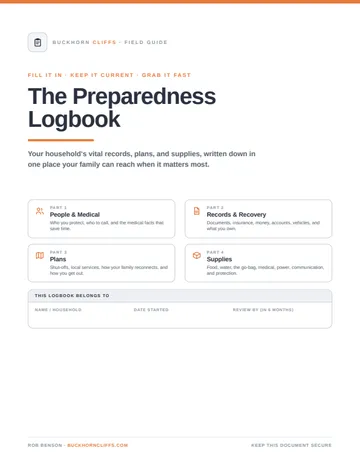
Every recipe and resource from the Prepper's Chemical Survival Guide, all six field guides to read here and download, the full audit and logbook, all twelve reference charts, and no ads.
My Manual · included
Build your own field manual
The most useful thing a membership gives you. Save any page on this site, recipes, charts, and whole field guides included. Arrange them in the order you want, name it, and print one manual with a cover and contents, or keep it as a PDF that opens with no signal.
- It works when this site does not
- Only your pages
- Anyone in the house can use it
- One current copy, not a pile of printouts
- The house binder
- A copy for the bug-out bag or truck
- A copy for family
- An offline PDF


Stay Ready
New entries, updates, and useful instruction.
Stay one step ahead on your preparedness journey.