Browse by need · 23 entries
Kits and Planning
Go-bags, documents, and the plan
When you leave in a hurry or the systems are down, paper and cash carry you. Keep copies of what matters, money that works without power, and the small comforts that hold morale.
Start with the full guide
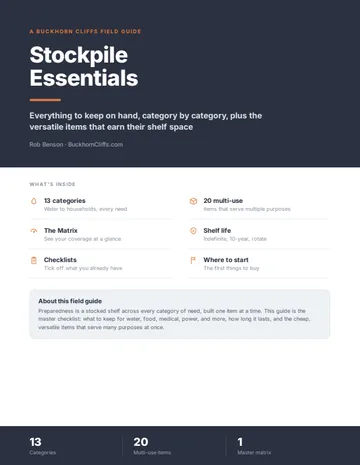 Field guideStockpile Essentials Field GuideThe master checklist: 239 items across 16 categories, the shelf life class of each, and the 20 multi-use items that cover the most jobs. 39 pages.Open the field guide
 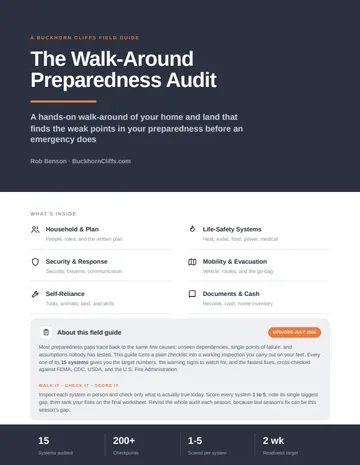 Field guideWalk-Around Preparedness AuditA walk through your home and land that scores 15 systems from 1 to 5 across 200 checkpoints. The lowest score is where to work next. 33 pages.Open the field guide
 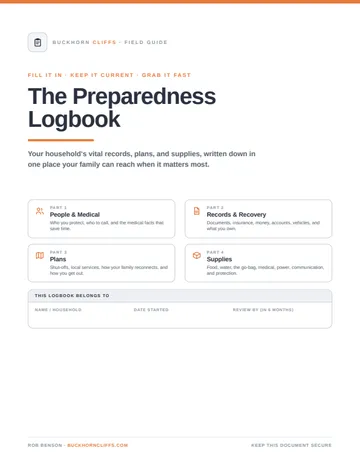 Field guideThe Preparedness LogbookThe one paper document that holds who to call, what everyone needs, where the shutoffs are, and what is on the shelf. 25 sections, 30 pages.Open the field guide Master guideWhat to Stock: The Long Shelf Life Master ListOne list of what to stock, sorted by need, with the real shelf life of each item, how to store it, and the products I buy.Open the full page
 Do the paperwork once, keep it forever
A single waterproof folder of copies, plus a record of your gear, plans, and supplies, is worth its weight in a crisis. The Preparedness Logbook field guide is built to hold all of it in one place.
Skills 1
Guides 19
Reference charts 2
Tools 1
Nothing matches those filters. Clear one and try again.
The checklist
Tick what you already have. Checks are saved on this device.
Documents, Cash and Comfort The boring stock that saves the day
Records
Cash & plan
Comfort & morale
Everyone in the Household The needs that do not fit a general list
Infants & young children
Elderly & mobility
Medical-dependent
Pets & livestock
Bug-Out and Go-Bags One packed bag, ready to walk out the door
The carry
The 72-hour loadout
Papers, cash & comms
Audit questions
From the walk-around audit. Tap a question for what a good answer looks like.
Who are you responsible for, including part-time and elderly family?
Count everyone the plan has to carry: the household, the parent across town, the kid home from college, the neighbor who will come to your door. Good means the roster is written, with each person's needs, in the Preparedness Logbook, and every number on this site is multiplied by it.
Does anyone have special needs: infant, elderly, disability, medical device?
Formula, diapers, a walker, a CPAP, oxygen, a powered chair: each one is a supply line or a power load the plan has to cover first. Good means each need is written next to the name and its supplies and power are sized before anything else. Medical Preparedness covers the medical side.
Are pets and livestock counted in every plan?
A dog drinks a gallon a day; the goats need hay and unfrozen water; evacuation means crates and carriers. Good means the animals are on the roster with their feed, water, medicine and a way to move them. The grab-and-go kit includes theirs.
Who handles water, food, and first aid?
If the answer is 'me' for all three, the plan fails the day you are hurt or away. Good means each job has a name and a backup, and the person who owns water knows where the drums, the filter and the pool shock are without asking.
Who handles defense and communication?
Good means one person owns the radios, the check-in schedule and the out-of-area contact, another owns the doors, lights and watch, and both have trained a backup. The communication plan and the security page describe the two jobs.
Who is responsible for children, the elderly, and animals?
In an evacuation someone has to be holding the kid, the leash and grandmother's medication list while everyone else loads the truck. Good means that person is named, is not also the one carrying water, and the children know the meeting points and how to call for help and give the address.
Common mistake
Keeping the only copy of everything on a phone or in the cloud.
Skills to learn
build a document kit · plan a route · manage a cash reserve
When it matters