Browse by need · 98 entries
Food
Eat-now, cook-from, and long-term bulk
Build in layers: food you can eat with no cooking, staples you cook from, and sealed bulk for the long haul. Store what your household eats, and rotate it.
Start with the full guide
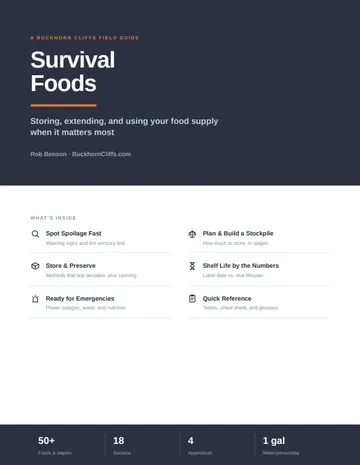 Field guideSurvival Foods Field GuideThe real shelf life of more than 50 foods, how to spot spoilage, how much to store, and how to build a stockpile in phases. 35 pages.Open the field guide GuideThe Food Shopping ListWhat to store, how much per person per month, how long it keeps, and why. Free one-page printable PDF.Open the full page Master pageSalt: The Full Field GuideTypes of salt, curing, brining, daily uses, and long-term storage, all on one page. Members print it as the 10 page field guide.Open the full page Master guideWhat to Stock: The Long Shelf Life Master ListOne list of what to stock, sorted by need, with the real shelf life of each item, how to store it, and the products I buy.Open the full page
 Store what you eat, and eat what you store
A stockpile you rotate through never expires on you. Deep pantry first, sealed bulk and a mill behind it. See the Survival Foods field guide for preservation and recipes.
Formulas 25
Compounds 3
Supplies 62
Guides 8
Nothing matches those filters. Clear one and try again.
The checklist
Tick what you already have. Checks are saved on this device.
Food and Pantry Eat-now, cook-from, and long-term bulk
Eat now, little or no cooking
Cook from staples
Long-term bulk
Protein & boosters
Flavor, morale & fresh
Audit questions
From the walk-around audit. Tap a question for what a good answer looks like.
How many days of food do you actually have?
Count calories, not cans: about 2,000 a day per adult, more in cold weather or hard work, and add it up for the whole household. Good is a month of shelf-stable food you already eat, with a deeper base of rice, beans and wheat sealed for the long haul. Start with the preparedness food shopping list and the master stocking list.
Is it calorie dense or filler?
A pantry of pasta, crackers and canned vegetables looks full and starves you. Good means fat and protein in the stack: oils, peanut butter, canned meat and fish, beans, whole grains, and the supplies that carry real calories per pound. Which foods gain the most in Mylar tells you what to seal deep.
Do you know how to prepare it without modern appliances?
Dry beans and wheat berries are useless without fuel, water and time, so the pantry has to match the stove. Good means you have cooked a full meal from storage on the backup stove, you own two manual can openers, and you know the soak and simmer times. Cooking, Fuel and Fire is the page.
What food spoils first if power fails?
The refrigerator is safe about four hours closed; a full freezer about 48 hours, half full about 24. Good means an appliance thermometer in each, and an eating order you already know: refrigerator first, freezer next, shelf-stable last. The spoilage cheat sheet tells you what to trust.
Do you have a plan to cook or preserve it quickly?
A freezer full of meat is a two-day problem. Good means a way to can, dry, cure or cook it before it turns: a pressure canner and jars, a smoker or dehydrator, salt, and the fuel to run them. The Survival Foods field guide has the methods and the freeze dryer is the long answer.
Can you realistically consume it in time?
If the plan is to eat 60 pounds of thawing beef in 48 hours, the plan is to lose most of it. Good means the freezer holds no more than you can cook, preserve or share in two days, and the rest of the food supply does not need cold at all.
Common mistake
Storing food nobody will eat, or with no way to cook it off-grid.
Storing bulk grain and beans with no fat, salt, or way to make them worth eating.
Skills to learn
seal mylar with oxygen absorbers · rotate stock · cook from scratch · cook dried beans and grain · build balanced meals · preserve a harvest
When it matters